A cidade que se tornou segura

Não foi a tolerância zero que levou segurança para Nova York; o Rio estaria no caminho certo

Click on the link just below to read a New Yorker article with relevance to crime-fighting in Rio de Janeiro, summarized here in Portuguese

Um artigo na revista New Yorker de 30 de janeiro 2012 por Adam Gopnik sobre o sistema carcerário norteamericano traz informações preciosas sobre como a cidade de Nova York se tornou segura. Gopnik, um escritor ultra-culto da equipe da revista, escreve sobre uma gama enorme de assuntos. Nesse artigo, ele descreve o “escândalo” das prisões nos EUA, que hoje contêm mais gente do que Stalin colocou em gulags no auge desses: acima de seis milhões.

Estranhamente, diz Gopnik, o número de presos caiu no estado de Nova York, no mesmo período em que a taxa de crime caiu vertiginosamente, entre os anos 1990 e 2010. Então, quais foram as causas da queda na taxa de crime?

Gopnik resume as surpreendentes conclusões do livro The City That Became Safe (A cidade que se tornou segura, inédito no Brasil)  de Franklin E. Zimring, publicado em novembro passado. Basicamente, a queda se deve a uma maior presença policial em áreas de maior risco; e revistas mais intensas de jovens em bairros de população negra e hispana.

Soa familiar?

A seguir, a tradução dos trechos mais relevantes para o leitor brasileiro, do artigo de Gopnik:

[…]A mudança não veio da resolução de patologias profundas sobre as quais a direita se obcecara — tais como encarcerar superpredadores, forçar para baixo o número de mães solteiras, ou mudar a cultura de dependência no sistema de bem-estar. Tampouco havia curas pelas causas subjacentes apontadas pela esquerda: injustiça, discriminação, pobreza. Nem houve efeitos mágicos surgindo de um aumento de abortos ou coisas do gênero. A cidade não ficou muito mais rica; não ficou muito mais pobre. Ao passo que o crime violento praticamente sumiu, não houve uma mudança significativa na configuração étnica , ou nas médias de nível socioeconômica ou de formação escolar. O policiamento de “janelas quebradas” ou de “saltadores de roleta”, ou seja a efetuação de choques em pequenos delitos visíveis, para criar uma atmosfera que desencorajava o crime, parece ter tido um efeito ínfimo; houve, escreve Zimring, uma grande diferença entre os lemas e a verdadeira estofa da época […]

[…] Em vez disso, pequenos atos de engenharia social, com a intenção de frear o crime, contribuiram para frear o crime. Nos anos 1990, a polícia de Nova York não lutou contra crimes menores em lugares seguros para começar a controlar o crime; porém colocou muitos policiais em lugares onde aconteciam muitos crimes– o chamado hotspot policing, ou policiamento em lugares quentes. Os policiais também iniciaram um programa agressivo e polêmico de revistas, “com a intenção de prender os tubarões e não os golfinhos”, como descreve Jack Maple, um dos pais do pr0grama– que envolvia o que se chama pejorativamente de profiling, ou perfilamento. Isso não era tanto racial, pois em um dado bairro todos os suspeitos seriam da mesma raça ou cor, como era social, utilizando os milhares de pequenos dados que os policiais já reconheciam. As comunidades de raça minoritária, assinala Zimring, pagaram um preço desproporcional em números de jovens revistados e detidos, mas também tiveram um ganho desproporcional na redução do crime. “Os pobres pagam mais e ganham mais,” Zimring coloca. Ele acredita que um programa “leve” de revistas poderia ser menos ofensivo com a mesma eficácia, e diz que ao reduzir o crime urbano, as revistas acabaram por reduzir em muito o número de jovens pobres e de origem racial minoritária, que passam longos períodos na cadeia. 

Zimring insiste, plausivelmente, que ele oferece uma reinvenção radical e otimista das teorias do que seria o crime e de onde ficam os criminosos, em grande parte porque desassocia o crime das minorias raciais. “Em 1961, 26% da população de Nova York  era de minorias afro americanas ou hispanas. Agora, elas respondem por metade da população — e o que isso nos traz, de maneira enormemente positiva, é a destruição dos preceitos simplistas de criminologia de oferta,” diz ele. Por “criminologia de oferta”, ele quer dizer a teoria conservadora de crime que sustentava que as circunstâncias sociais produziam uma certa quantidade líquida de crimes que aguardavam por serem cometidos; se você os freava aqui, eles estouravam ali. A única maneira de de frear o crime era de prender todos os criminosos em potencial. Na verdade, a atividade criminosa parece ser igual a qualquer outra escolha humana– uma questão de ocasião e oportunidade contingencial. O crime não é a consequencia de um certo número de criminosos; criminosos são a consequencia de um certo número de oportunidades para cometer crimes. Feche o mercado aberto de drogas em Washington Square, e ele não irá migrar automaticamente ao Tompkins Square Park. Ele cessa, ou os traficantes vão para dentro de casa, onde os negócios continuam, sem o crime violento.

E, num ciclo virtuoso, a taxa reduzida de crime alimenta uma nova queda no crime. Quando seus amigos não assaltam mais, há menos chance de que você vá assaltar. Zimring falou, numa entrevista recente, “Lembre-se, ninguém nunca ganhou a vida assaltando. Não há salário mínimo no crime violento.” De alguma forma, ele afirma, é uma forma de lazer, de estilo de vida: “O crime é comportamento de rotina; é uma coisa que as pessoas fazem e se acostumam a fazer.” E é aí que reside sua fragilidade essencial. O crime deixa de acontecer como resultado de “forças cíclicas que operam em coisas conjunturais e contingenciais, e não pela descoberta de ligações essenciais de motivação profunda.” Os conservadores não gostam desse ponto de vista porque revela que não adianta ser durão; os liberais não gostam porque aparentemente tampouco adianta ser bonzinho. Frear o crime não depende de reverter patologias sociais ou de aliviar queixas sociais; depende da construção de pequenas e irritantes barreiras à entrada.

Gopnik lembra que é só olhar o crime de colarinho branco para entender que não se trata de uma população fixa de criminosos que simplesmente vai se mudar de escritório, hora que o governo descobrir um caso de insider trading.  “[…] conseguir que a S.E.C. feche as oportunidades é um bom caminho para limitar a gama da patologia,” escreve no New Yorker.

* * * * *

Profundas tendências sociais talvez apareçam no futuro para esclarecer o momento atual.

[…] É pelo menos possível, por exemplo, que a chegada do telefone celular ajudou a tirar o tráfico de drogas do espaço público, de maneira que reduziu o crime. Pode ser que o valor real das revistas era que se tratava de uma estratégia na qual a polícia acreditava; como a história militar revela, uma estratégia ruim é muitas vezes melhor do que nenhuma, sobretudo se o outro lado pensa que é uma estratégia boa. Mas uma coisa é certa: as epidemias sociais, de crime ou de castigo, podem se curar mais rapidamente do que esperamos com mecanismos mais simples e superficiais do que imaginamos. Passar um curativo por cima de uma ferida grave é na verdade uma jogada decente, se o curativo contribui para que a ferida comece a sarar. 

Por fim, Gopnik diz que muitas vezes evitamos tratar de um problema social porque nos parece fazer parte de um desafio tão grande que achamos impossível enfrentá-lo. Nos parece que teríamos que mudar a sociedade toda para solucionar o problema. “[…] humanidade e senso comum fizeram com que o problema insolúvel simplesmente levantou e foi embora,” ele conclui.

Provavelmente o Secretário de Segurança Pública do Estado do Rio de Janeiro, José Mariano Beltrame, iria concordar.
Posted in Brazil, Transformation of Rio de Janeiro / Transformação do Rio de Janeiro, Uncategorized | Tagged , , , | Leave a comment

Police strikes end in Rio and Bahia

Labor relations evolve in Brazil

Rio police voted yesterday to end their short-lived strike, and focus on freeing 27 members of the force arrested for striking. A day earlier their Bahian colleagues did the same.

Though the approach of Carnival served to pressure the state government into pay increases for security forces, the holiday may also have taken the wind out of their sails. With blocos already in the streets and popular focus shifting to fun (with due concern over the safety and spending of revelers, both locals and tourists), the strikers found little support for additional demands.

Latin American history could easily be written as the story of how the elite have managed the needs and wants of the poor. Over time the identity of that elite has changed, with some socioeconomic mobility occurring, but the dynamic has remained the same.

Slavery was abolished late in Brazil, only in 1888, with no provision made for the newly-freed.

In the 1940s and 1950s, Brazil’s strongman Getúlio Vargas coopted labor movements to keep them under his thumb, setting up a system that largely persists to this day– strangling efforts to make the Brazilian economy more agile and dynamic.

In the same spirit, in 1962 Brazil instituted a paternalistic thirteenth salary, awarded to workers at year-end with the tacit idea that they are incapable of planning ahead for holiday spending. Imagine doing away with that!

Lula’s metalworkers’ movement was illegal back in the 1970s and 1980s, under the military government, so strict were Brazil’s labor regulations. The movement turned into a political party which during his two terms (2002-2010) awarded labor groups and leaders enormous access to funding.

Meanwhile, the world has changed.  Workers have greater access than ever t0 information and a greater ability to communicate among themselves. Brazil’s economy is growing, inequality is lessening and labor has the upper hand, for the first time in history.

It’s not just the police who are straining at the reins; construction workers on the remodeling of Rio’s Maracanã stadium struck over work conditions last year. In the state of Rio, workers are currently in conflict in Itaguaí, where Petrobras is building a huge petrochemicals complex, Comperj.

This time around, no great rupture occurred. After only a few days of a semi-strike, the Rio police got raises and Carnival masks will be donned. But come Ash Wednesday, all would do well to take stock of the evolving power equation, and reflect on where it will lead us next.

Posted in Brazil, Transformation of Rio de Janeiro / Transformação do Rio de Janeiro | Tagged , | 3 Comments

Presos dois pela morte do Gambá

Não se pode matar um jovem negro de origem popular e pensar que nada vai acontecer

Hoje de manhã, de acordo com o jornal Extra, dois suspeitos foram presos pela morte do Gambá, 22, dançarino do passinho, no dia 1 de janeiro.

De acordo com o irmão do Gambá, Johnny Peter Rocha, um dos suspeitos seria o segurança do posto de gasolina onde ele foi tomar café de manhã depois de um baile funk de reveillon. Johnny diz não saber quem seria o segundo suspeito, identificado na matéria do Extra apenas como “morador de via”.

“Quero ver as imagens,” o Johnny falou ao RioRealblog por telefone, hoje de manhã. Ele se refere a um vídeo que teria sido gravado pela câmera de segurança do posto, que estaria com a polícia. Somente vendo as imagens “deles agredindo meu irmão”, ele acrescentou, é que a história chegaria a um fim para ele e sua família. Foi Johnny (aqui falando na TV Globo logo após o assassinato) quem descobriu, dia após o crime, que Gambá– Gualter Rocha– havia sido enterrado como indigente.

Leia mais sobre o caso aqui. Amanhã, domingo dia 12 de fevereiro, o programa Fantástico promete desvendar o assassinato desse talentoso jovem tão bonito e cheio de vida.

Posted in Brasil, Transformation of Rio de Janeiro / Transformação do Rio de Janeiro | Tagged | Leave a comment

Polícia no Rio de Janeiro de greve: haja coragem 2

For English, click here

O primeiro dia de greve dos policiais no Rio de Janeiro não foi muito fora do comum. Os cariocas trabalharam, foram à praia, cruzaram a cidade, e também entraram no espírito de Carnaval, com desfiles dos primeiros blocos da temporada. Tudo sem violência. Dos três mil policiais que patrulham as 19 comunidades pacificadas do Rio, apenas 14 soldados faltaram, de acordo com a TV Globo— que também noticiou que 123 guardavidas não compareceram no serviço, e que a polícia civil trabalhou normalmente. Houve a prisão de um número relativamente pequeno de policiais que fizeram greve. De acordo com as notícias da mídia principal, a adesão à greve foi maior no interior do estado, sobretudo em Campos, cidade do ex governador Anthony Garotinho.

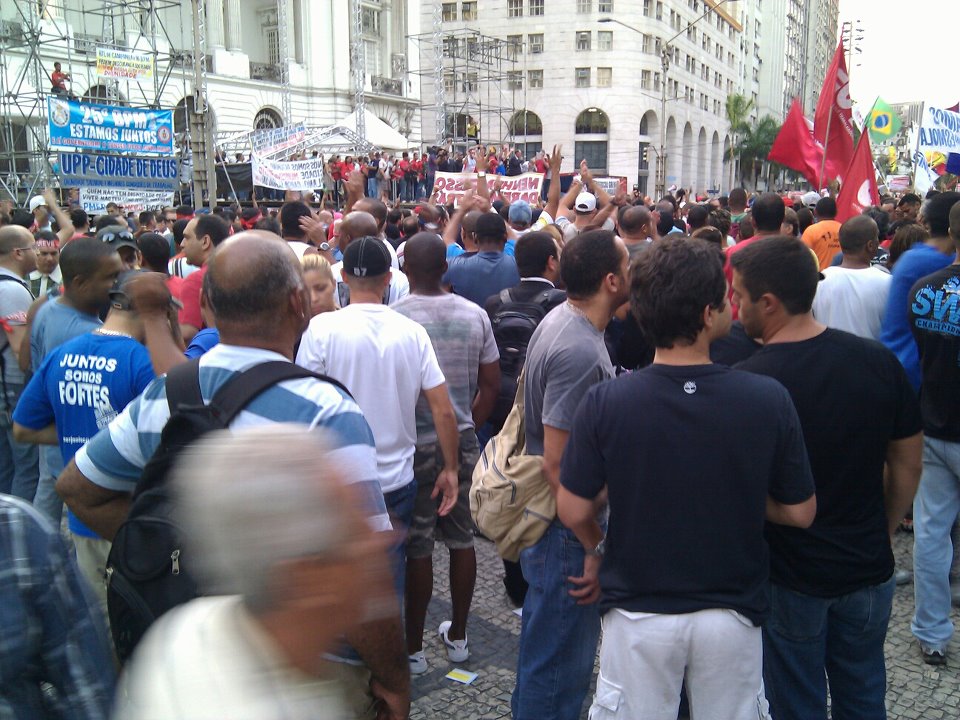
Pode muito bem ser que a multidão de homens ruidosos na Cinelândia ontem à noite, soltando fogos, gritando palavras de ordem e levantando os braços– uns três mil policiais e bombeiros que decidiram fazer greve– não representem a massa das forças de segurança fluminense (70 mil). Ou que a maioria sente a pressão das prisões e das ameaças das autoridades. Até a presidente Dilma Rousseff  criticou os grevistas, sobretudo os do estado da Bahia.

Existe o perigo de uma greve de forças de segurança se espalhar pelo país, mas o governo federal se diz preparado para essa eventualidade.

Demanda reprimida surge como prioridade

Quaisquer que sejam os motivos reais, pessoais ou políticos dos grevistas, estão de fato com muita raiva. Nos anos 1960, os militares brasileiros reprimiram demandas da camada mais pobre da população, com um golpe que manteve até 1985 um governo autoritário no poder. A volta à democracia foi gradativa, com uma cuidadosa administração por parte das elites. Apesar do Lula ter continuado muitas práticas econômicas e políticas da velha guarda, o seu governo entre 2002 e 2010 marcou uma volta à cena principal das demandas reprimidas ao longo de décadas.

Administrá-las não é tarefa fácil, como estão descobrindo o governador Sérgio Cabral e a TV Globo. Concederam-se grandes aumentos de salário, mas as forças de segurança, ressentidas e agora se sentindo mais poderosas do que nunca, não os acham suficientes. Com base em escutas telefônicas que foram para o ar pelo Jornal Nacional quinta-feira à noite, prendeu-se um bombeiro por incitar crimes contra a lei militar,  e seus colegas querem sua libertação. Em dois anos teremos a eleição para governador, e pelo menos parte dessa história provém dos preparativos do ex-governor Anthony Garotinho, que apoia os grevistas.

O momento de crescimento econômico e de euforia geral no Brasil e sobretudo no Rio de Janeiro, com uma crescente escassez de mão de obra qualificada e não qualificada, constrói um cenário em que diversos trabalhadores se sentem sempre mais no direto de fazer reivindicações. Resta saber se a sociedade brasileira, chacoalhada por mudanças socioeconômicas em todas suas camadas, consegue digerir essa e muitas outras implicações. Hoje em dia pouca coisa acontece de jeito gradativo.

Acompanhe o Twitter do @riorealblog e curte a página Facebook para ter acesso a maiores informações.

Posted in Brasil, Transformation of Rio de Janeiro / Transformação do Rio de Janeiro | Tagged , | Leave a comment

Rio police decide to strike: do they dare? 2

The first day of the police strike in Rio de Janeiro wasn’t very unusual. Cariocas worked, went to the beach, crossed the city, and also got into the Carnival spirit, with some of the first blocos of the season parading in the streets. There was no violence. Of the 3,000 cops who patrol the nineteen pacified favelas of Rio, only 14 officers failed to show up, according to TV Globo— which also reported that 123 lifeguards stayed home, and that the civil (investigative) police worked as usual. A relatively small number of striking police officers were arrested. According to the mainstream media, the strike was felt more in the interior of the state, especially in Campos, hometown of former governor Anthony Garotinho.

It may well be that the crowd of some 3,000 boisterous men in Rio’s Cinelândia square last night, setting off firecrackers, chanting and punching the air with their fists– police and firemen who voted to strike– don’t fully represent Rio state’s public safety forces (70,000). Or that most of them feel the pressure from the arrests and threats coming from government officials. Even president Dilma Rousseff  criticized the strikers, especially those in the state of Bahia.

There is a danger of strikes by public safety personnel spreading throughout the country, but the federal government says it’s prepared for the eventuality.

Repressed demands to the fore

Whatever the real, personal or political motives of the strikers, they are truly angry.

In the 1960s, Brazil’s military put a lid on demands from the poor, with a coup that kept an authoritarian government in power until 1985. The return to democracy was gradual, with elites carefully managing the process. Though Lula carried on with old political and economic practices, his 2002-2010 government marked the return to center stage of those the long-repressed demands.

Managing them is no easy task, as Governor Sérgio Cabral and TV Globo are finding out. Large pay raises were given, but aren’t considered to be enough by angry security forces who are now feeling their muscle. A fireman was arrested for inciting the practice of crimes against military law, on the basis of a wiretapped phone conversation aired strategically on Globo Thursday night, and his colleagues want him freed. A gubernatorial election is coming up in a couple of years, and at least some of the action stems from preparation by ex-governor Anthony Garotinho, who’s sided with the strikers.

This time of economic growth and general euphoria in
Brazil and especially in Rio de Janeiro, with a growing scarcity of skilled and unskilled labor, is setting up a scenario in which many worker groups feel ever more correct in making demands. What remains to be seen is if Brazilian society, shaken at every level by socioconomic change, can digest these and other implications. Nowadays, not much happens gradually.

Follow the @riorealblog Twitter and like the Facebook page for access to additional information.

What follows below is a translation of a very complete description of the situation, from Friday’s O Dia newspaper.

Rio –  Firemen, and civil and military police began a general strike Thursday night. The decision was taken in an assembly in Cinelândia, in the center of Rio. According to the movement’s leadership, the strike has no end date. About 3,000 participated in the rally.

Movement leaders had sworn there would be a strike if any item on their list of demands was not met by the government. They demand the release of soldier Benevenuto Daciolo, arrested Wednesday night, transportation and meals support of R$ 350, a wage floor of R$ 3,500 a month and a forty-hour workweek.

Police will stay at precincts

Military police, including those off duty and on vacation, said that starting today they would stay in their precinct stations and only respond to emergencies, with 30% of the force at most. Fernando Bandeira, president of the civil police employees union, advised cariocas to stay home.

In the civil police, only the homicide division will fully function. The other units will respond only to emergencies, and do the paperwork necessary for removing bodies and for robberies.

“As long as the government doesn’t negotiate a career and salary plan, we will keep our arms crossed,” promised the president of the union of civil police, Carlos Gadelha.

As for the military police, the strategy is for everyone to go to all units to avoid the arrest of parts of the force. Last June, 437 firemen and two military police were detained after the invasion of  fire department headquarters in Praça da República, downtown.

“If they arrest one, they’ll have to arrest everybody”, Wellington Machado, a leader from the 22nd military police precinct in Maré, told the crowd.

Federal troops at any moment, says Beltrame

Army troops, in the case of a strike, can be called up at any moment to guarantee the safety of residents and visiting tourists, according to State Public Safety Secretary José Mariano Beltrame. On Thursday in Brasília, he said a plan has been ready since the 2007 Pan-American Games. “We have a protocol of actions built up since that year, and the focus is public interest and keeping the peace,” he underscored.

Security authorities met on Wednesday with top officials of the Eastern Military Command to agree on details of a possible request for help from federal troops. Earlier, Beltrame said he believed an agreement with public safety professionals would be forthcoming, appealing to the “common sense” of employees.

Legislature approves increase

Rio’s state legislature voted Thursday to approve, by sixty votes to one (two abstentions and one absent), a bill conceding a raise of 38,81% to 122,640 public servants in the safety area, to be completed by February 2013.

Governor Sérgio Cabral repeated on Thursday that he saw no possibility of a strike. He cited the increase given, saying it involves an impact of de US$ 1 billion equivalent on public coffers and said he trusts in the state’s institutions.

“Safety professionals know this isn’t the best method and they recognize that we are working on this and that there is still much to be done. If all those who came before me had done the same, the military police’s wage scale would be one of the best. But they did nothing before me,” the governor stated.

Fireman jailed in Bangu 1

Judge Ana Paula Figueiredo, from the auditing division of the military court, yesterday decreed the preventive arrest of fireman Benevenuto Daciolo. The request came from the internal affairs chief of the force, Edson Senra. In her decision, the judge stated that the fireman had traveled without authorization to Bahia and was caught by wiretaps speaking with strikers from the Bahian military police.

In one section of the audio, Daciolo claimed there would be no Carnival in Bahia, nor in Rio. The judge said his arrest was necessary to guarantee public order and military discipline. The soldier is accused of inciting others to practice military crimes.

Before the judicial order was given, the fireman, one of the leaders of the group, was arrested — up to then for administrative reasons for 72 hours — as he got off a plane at Tom Jobim International Airport, Wednesday night. He is in the Bangu 1 maximum security prison. “It’s just one more abitrary act,” he lamented to O DIA on being arrested.

The soldier explained that he was returning from Salvador, Bahia, where he’d participated in strike negotiations. “For reasons of public order, he went to Bangu 1”, said the State Civil Defense Secretary, Sérgio Simões. Last year, Daciolo took part in the invasion of the force’s headquarters.

Posted in Brasil, Transformation of Rio de Janeiro / Transformação do Rio de Janeiro | Tagged | 1 Comment

Greve de polícia no Rio de Janeiro: haja coragem

ATUALIZAÇÃO: Aparentemente, uma greve pelas forças de segurança dificilmente irá acontecer no Rio de Janeiro. Por um lado, concessões; por outro, uma denúncia de mau comportamento de parte de líderes do movimento grevista, transmitida essa noite pelo Jornal Nacional da TV Globo.

Dia 8, quarta-feira à noite, o governador Sérgio Cabral soltou uma nota anunciando uma antecipação de reajuste salarial que será votado pela assembleia legislativa nesta sexta-feira.  De acordo com o jornal O Globo, o deputado André Correa (PSD), líder do governo, disse, “‘Nós confiamos no espírito público e a responsabilidade dos servidores da segurança Pública do estado. O governo vai fazer um grande esforço fiscal de forma para conceder este aumento, de quase 40%, em apenas um ano. Além disso, sinalizou um novo aumento salarial, bastante significativo em 2014. Com isso, o salário base de um soldado da PM, que em 2007, quando o governador assumiu, era de R$ 700, chegará a R$ 2.100 em fevereiro do ano que vem. E a quase R$ 3.000 em 2014.'”

Na mesma noite, ouviu-se na TV Globo, que até então praticamente não noticiara a possibilidade de uma greve, uma gravação na qual lideres de movimentos grevistas das polícias militares do Rio de Janeiro e da Bahia parecem estar combinando atos de apoio e de vandalismo.

Pelo jeito, os policiais do Rio ficam sem apoio popular pelo movimento grevista.

*******

Dia 17 começa o carnaval, com 250% banheiros portáteis a mais do que no ano passado. E possivelmente, com policiamento bem escasso.

As polícias militar e civil do Rio, mais seus bombeiros, ameaçam entrar em greve nesta sexta-feira.

O momento não podia ser melhor– ou pior. A polícia militar do estado da Bahia está em greve, com tropas do exército cercando grevistas acampados na assembleia legislativa. O governo americano aconselha adiar qualquer viagem à Bahia, e ontem a TV Globo noticiou que operadores de pacotes de turismo no estado relatam uma taxa de cancelamento em dez porcento.

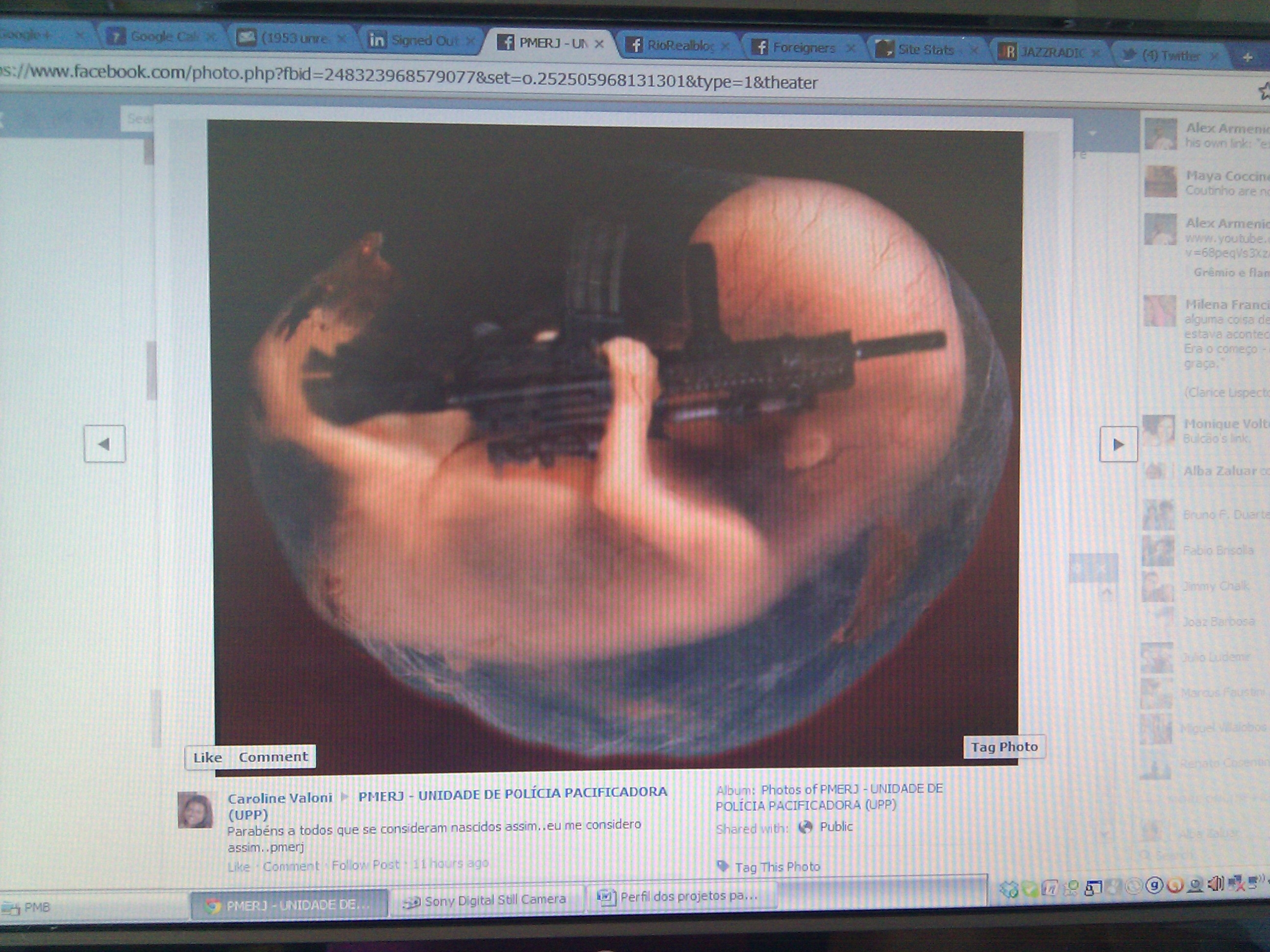
Da página Facebook da polícia pacificadora: "Parabéns a todos que se consideram nascidos assim..eu me considero assim..pmerj", postou uma policial.

No Rio de Janeiro, policiais estão postando freneticamente no Facebook e em blogs, com pouca cobertura na mídia tradicional sobre a possibilidade de uma greve (ou sobre reivindicações, condições de trabalho, reflexos em potencial, e a política por trás da ameaça de greve). O governador Sérgio Cabral já aumentou salários e melhorou a compensação por outros meios.

Contudo, a polícia ainda ganha muito mal– com muitos policiais morando em favela inclusive– e, talvez, mais importante ainda, ela tem consciência plena de sua importância na nova Rio de Janeiro. O crime está em queda e crescem os valores imobiliários e  níveis de turismo, em grande parte devido ao programa de pacificação policial que data de dezembro de 2008, atualmente estendido a 19 favelas.

“Nós trabalhamos para que você possa viver em segurança na Zona Sul,” vangloriou-se um oficial da tropa de choque ao RioRealblog há algumas semanas na favela do Vidigal, recém ocupada. Mas os policiais não protegem apenas os mais abastados. Nas favelas pacificadas do Rio muita gente já entrou na nova onda, mudando hábitos e comportamentos; sem um policiamento adequado, os criminosos poderiam facilmente começar uma retomada de territórios, dando início a uma onda de vingança naqueles que consideram traidores.

As forças de segurança cariocas tem uma reunião marcada com o governador hoje. Uma manifestação está planejada para amanã na Cinelândia, com a greve marcada em princípio para sexta-feira.

A página Facebook do RioRealblog é uma boa fonte de notícias quentes, bem como o Twitter, em @riorealblog.

Posted in Brasil, Brazil, Transformation of Rio de Janeiro / Transformação do Rio de Janeiro | Tagged , | Leave a comment

Police strike in Rio: do they dare?

UPDATE: Apparently a strike by Rio de Janeiro security forces is unlikely. On the one hand, concessions have been made; on the other, evidence of illegal and dangerous behavior by strike movement leaders, was aired last night on the TV Globo national news program, Jornal Nacional.

On the night of Wednesday February 8,  Governor Sérgio Cabral released news of an additional wage increase to be voted Friday by the state legislature.  According to O Globo newspaper, state representative André Correa (PSD), speaker of the house, said, “‘We trust in the state’s public safety employees’ public spirit and responsibility. The government is going to make a huge fiscal effort to concede this increase, of almost 40%, in just one year. In addition, we have planned another significant wage increase for 2014. Thus the base wage of a military police soldier who was making R$ 700 when the governor took office in 2007 will be up to R$ 2,100 in February of next year. And almost R$ 3,000 in 2014.'”

The same night, TV Globo broadcast a taped telephone conversation in which police strike leaders from Rio and Bahia  seem to be planning mutual support and acts of vandalism. Until then Globo had barely covered the possibility of a strike in Rio.

It looks like Rio police won’t be getting much popular support for a strike movement.

******

Carnival starts a week from Friday, with 250% more porta-potties. And possibly, a dearth of police.

Rio de Janeiro’s military (street) and civil (investigative) police forces, plus its firemen are threatening to strike starting this Friday.

The moment couldn’t be better– or worse. The military police of the northeastern state of Bahia are currently on strike, with army troops surrounding strikers holed up with their families in the state legislature building. The U.S. government has advised putting off travel to Bahia, a prime spot for Afro-Brazilian Carnival celebrations, and Globo TV reported today that tourism package operaters have seen a ten percent cancellation rate.

From the pacification police facebook group page: "Congratulations to all those who think of themselves as having been born like this. I think of myself this way", posted one police officer.

In Rio, police are posting frenetically on Facebook and in blogs, with not much mainstream coverage on the possibility of a strike (or on demands, work conditions, potential impact or the politics involved). Governor Sérgio Cabral has increased salaries and improved compensation in other ways.

But the police are still poorly paid– with many themselves living in favelas– and, perhaps, most important, they’re fully aware of their importance in the new Rio. Crime is down and real estate values and tourism are up, largely due to the police pacification program begun in December 2008, which now extends to 19 favelas.

“We work so you can live safely in the South Zone,” a shock troop officer in the recently-occupied Vidigal favela boasted to RioRealblog, just a couple of weeks back. But the cops aren’t only protecting the upper classes. In Rio’s pacified favelas many people have let down their guard and developed new habits and behaviors; without enough police, criminals could easily start to retake territories and begin a wave of revenge on those they consider to be traitors.

Rio’s security forces have a meeting scheduled with Cabral tomorrow. A demonstration is planned for Thursday in Cinelândia, with the strike tentatively set for Friday.

RioRealblog’s Facebook page is a good source for continuous news updates, as is Twitter, on @riorealblog.

Posted in Brazil, Transformation of Rio de Janeiro / Transformação do Rio de Janeiro | Tagged , , | 1 Comment

“Crime, Preços de imóveis, e desigualdade: o efeito das UPPs no Rio de Janeiro”

Click “Crime, House Prices, and Inequality: The Effect of UPPs in Rio” for English

Esse é a tradução do título de um novo paper econômico apresentado ontem na Fundação Getúlio Vargas no Rio de Janeiro. O estudo será de grande interesse aos pesquisadores de gentrificação em favelas e territórios próximos a elas, entre outras áreas de estudo.

Os autores formam uma parceria inusitada.

Benjamin Mandel é um jovem economista norteamericano que trabalha com bastante autonomia no Federal Reserve Bank de de Nova York. Economista Claudio Frischtak é presidente da Inter. B – Consultoria Internacional de Negócios, com foco em serviços de consultoria econômica, estratégica e financeira, ao setor privado e a governos. Juntos, eles analisaram dados sobre 3,3 milhões de imóveis do site Zap Imóveis, do mercado imobiliário de vendas no Rio de Janeiro, em conjunto com estatísticas de crime do Instituto de Segurança Pública.

Ben Mandel apresenta o paper na FGV

O paper que resultou conclui que entre 2008 e meados de 2011, “as UPPs explicam aproximadamente 15% dos aumentos de preço nos mercados formais de imóveis no Rio de Janeiro, uma observação que ligamos à contribuição das UPPs à queda das taxas de crime”.

Os economistas também descobriram que a queda de crime pós UPP levou a maiores incrementos de valor para os imóveis mais baratos, reduzindo a desigualdade de preço no mercado como um todo. Após a instalação de uma UPP na região, os imóveis, por exemplo, nas duas pontas da rua Saint Roman, que passa pela favela do  Cantagalo em Copacabana e continua até a favela Pavão-Pavãozinho em Ipanema, provavelmente tiveram maiores altas de preço do que os apartamentos na Avenida Atlântica.

Essa redução, dizem os autores, significa menos desigualdade de riqueza, porque em todas as classes sociais, o imóvel configura um elemento chave do patrimônio.

Os resultados para a versão deles do índice Gini de desigualdade de renda, eles ressaltam, ilustra “uma nova dimensão de importância potencial das políticas públicas que visam ou reduzir a criminalidade ou a desigualdade. As tentativas atuais de melhorar disparidades econômicas tendem a focar em transferências de renda, e são raras as políticas capazes de reformatar a distribuição de riqueza de maneira significativa.”

Tal resultado, eles acrescentam, pode ser útil em outras localidades.

O estudo não incluiu dados de preços dos imóveis de favela. Se os dados fossem incluídos, comentou o economista da FGV Marcelo Neri, ambas conclusões seriam ainda mais fortes.

Quem é proprietário de imóveis em ruas do Rio de Janeiro como a Saint Roman não precisa de economista para saber que a UPP é benvinda. Durante décadas, muitos imóveis se degradaram ou foram subutilizados. Agora, há gente cavando e martelando pela cidade toda. Na Zona Sul, bares de tapas e albergues se espalham na mesma medida que os pé sujos somem.

Enquanto os donos de elefantes brancos finalmente se juntam ao mercado, o boom cria problemas para outros cariocas. Comprar um imóvel, e especialmente alugar um apartamento, viraram missões quase impossíveis em grande parte da Zona Sul. E, fora o fato de que os proprietários em favela raramente detém título ao patrimônio recém-valorizado, que até certo ponto inibe a liquidez, não existe uma política para proteger aqueles que sofrem pressão para sair de seus bairros, em função do boom, tanto na favela como na cidade formal.

Claramente a nova política de segurança pública está transformando a geografia do Rio de Janeiro, e arquitetos, construtores, engenheiros e empresas de mudança estão surfando a onda. Resta saber exatamente quem vai morar onde.

A cobertura sobre esse paper no Estado de São Paulo está aqui.

Posted in Brasil, Transformation of Rio de Janeiro / Transformação do Rio de Janeiro | Tagged , , , , , , | Leave a comment

“Crime, House Prices, and Inequality: The Effect of UPPs in Rio”

An unlikely duo presented a striking new economic paper today at the Getúlio Vargas Foundation in Rio de Janeiro, that will be of great interest to those researching gentrification, among other areas of study, in favelas and areas contiguous to them.

Benjamin Mandel is a young American economist who enjoys quite a bit of research autonomy at the Federal Reserve Bank in New York. Economist Claudio Frischtak is President of Inter. B – Consultoria Internacional de Negócios, with a focus on economic, strategic and financial advisory services to the private sector and government. Together, they analyzed the Zap Imóveis site data on 3.3 million housing units on the Rio de Janeiro real estate sales market, together with crime data from the Instituto de Segurança Pública.

Ben Mandel presents the paper at the FGV

The resulting paper found that between 2008 and mid-2011, “the UPPs accounted for about 15 percent of price growth in Rio’s formal property markets, an observation which we link to the contribution of the UPPs to falling crime rates”.

The economists also found that the post-UPP drop in crime led to greater increases in value for lower-priced housing, than for higher-priced housing, reducing price inequality. For example, after the installation of a UPP covering Cantagalo and Pavão-Pavãozinho favelas in Copacabana and Ipanema, housing on either end of the Rua Saint Roman, which runs through both, has probably seen larger percentage price increases than apartments on Avenida Atlântica.

This reduction, the authors claim, means reduced inequality in wealth, because for all social classes real estate is a key element in personal wealth.

The results for their version of the income inequality Gini index, they add, illustrates “a potentially significant new dimension of policies aimed at reducing either crime or inequality.” Existing attempts to ameliorate economic disparities tend to focus on income transfers; policies to reshape wealth distribution in any meaningful way are uncommon.

Such a finding, they add, may be useful in policymaking elsewhere.

The research didn’t include real estate price data on favela housing. If it had, commented FGV economist Marcelo Neri, both findings are likely to be even stronger.

Those who own property on Rio streets such as Rua Saint Roman need no economist to tell them that a UPP is welcome news. Many units were degraded or underutilized for decades. Now workers are digging and banging everywhere. In the South Zone, tapas bars and hostels are springing up at almost the same pace as the corner bars, pé sujos, are disappearing.

While white elephant owners have finally joined the market, the boom has created problems for other cariocas. Buying property — and especially renting an apartment– have become something of a missão impossivel in much of the South Zone. And aside from the fact that few favela homeowners hold title to their newly-appreciated assets, which to some extent inhibits liquidity, there is no policy protecting those being pushed out by the real estate boom, both in favelas and the formal city.

Clearly the new public safety policy is changing the geography of Rio, and architects, builders, engineers and moving companies are on a roll. What remains to be seen is just who will end up living where.

Coverage on this study in the Estado de São Paulo newspaper is here.

Posted in Brazil, Transformation of Rio de Janeiro / Transformação do Rio de Janeiro | Tagged , , , , | 2 Comments

The enigma of the favela by Luiz Fernando Janot

Herewith an English translation of an article appearing on O Globo’s opinion page Jan. 28 2012 by a top urban planner and architect in Rio de Janeiro. He’s the first to come out publicly and question the delay in the implementation of the second phase of the Morar Carioca program.

The article idealizes the favela to a certain extent, and incorrectly suggests the current existence of a policy of favela substitution by public housing.

Brazilians are perplexed by the “enigma” of overwhelming community spirit present in many favelas, vis-à-vis its scarcity in middle and upper-class neighborhoods in the formal city. In the absence of viable institutions acessible to the poor, neighbors and family must help out.

But from an American perspective, it’s also clear that community exists in favelas due to less disparity and less distrust among residents there, while this is not the case in the formal city. As Brazil become a more egalitarian society, this dichotomy is bound to lessen. Also, favelas are not growing much nowadays, contrary to what the author says.  Still, his view that favelas should occupy more space in public policy thinking for the city of Rio is correct.– J.M.

* * * * * * * *

A large number of people already regularly go to favelas

A Greek legend tells us that the Sphinx, a mythological creature from the Egyption and Mesopotamian civilizations, on invading the city of Thebes and destroying all its crops, threatened the natives who couldn’t decipher his enigma, saying: decipher me or I’ll devour you. The lesson to be taken away from this passage may not be enough to urge society to reflect on the true meaning of favelas in the city’s structure. But it does somehow point the way to deciphering their enigma; coming to know their reality, their complex spatial organzation, their particularities, vicissitudes, faults, virtues, and most of all, their culture.
This may sound strange, but visitors who tread the narrow streets of old medieval cities, or who climb the steep winding pathways of the Greek isles, enjoying their special beauty, may not realize that those streets and buildings were in remote times the habitat of the poor. The transformation of these places into welcoming environments is indisputablydue to Europeans’ respect for the original spatiality of their cities and the wish to offer better life conditions for their residents. Thus it doesn’t seem impossible to imagine a similar future for carioca favelas.
Society’s growing support for forms of social integration with pacified favelas indicates that this possibility is viable. We see a large contingent of people regularly visiting  favelas, participating in events and interacting with the local population, without the concerns of earlier times. Political will is all it takes to definitively urbanize and integrate these areas into the urban context of the official city. But this is not what seems to be happening. The mayor’s decision that favela urbanization would be the main legacy of the 2016 Olympics led to the December 2010 hiring of forty technical teams selected in the Morar Carioca contest, to develop urbanization projects and housing improvements in a series of favela groupings. As of today however, more than a year after the contest results announcement, the process of hiring the teams is still making its way through the halls of official bureaucracy, with no solution in sight, while favelas continue to grow in a disorderly fashion, stimulated by the demand for housing and family growth.Despite the generalized impression that progress has always passed these communities by, it’s surprising to discover the existence of creative solutions in the ways that space is constructed and occupied. A closer look reveals an extraordinary variety of embodied technical and cultural manifestation, from generation to generation, by way of a rite of passage that values knowledge and uses it as a tool for survival, given the lack of material resources. The biased policy in favor of total removal of favelas and the construction of public housing in their place is wrong in both practical and conceptual terms. Today the old rhetoric in defense of urban and architectural solutions that look down on the city’s cultural legacy is no longer acceptable– and the favela is part of that legacy. Such thinking in fact only favors contractors interested in taking on jerry-built large construction projects, and politicians whose careers rest on such feats.

It must be understood that the residents of such communities have life stories, and that these include material and immaterial investments that cannot be ignored. In favelas and illegal housing developments, culture is manifested by way of individual housing and the social organization of public spaces. Thus the life experience of these people, incorporated into urbanization projects and housing improvements, is the best path towards spatial reallocation in these communities, and consequently, for their integration into the social fabric of the city. To ignore the fact that the favela has been part of carioca culture for more than a century is to deny its preexistence and its spontaneous way of life. Thus it’s impossible to justify the use of universal solutions to resolve particular problems of a specific nature. We live in a time of deep transformations where local cultures will certainly play a relevant role. In the midst of a whirlwind of ideas, concepts and diverse interests, only time will tell if the enigma of the favela was deciphered. We shall see.

The author’s email is lfjanot@superig.com.br

Posted in Brazil, Transformation of Rio de Janeiro / Transformação do Rio de Janeiro | Tagged , , , | 8 Comments