Sem o Urani, nada de RioRealblog

Conheci André quando ele era Secretário Municipal do Trabalho, no fim dos anos 90. Fui conversar com ele junto com um grupo da Associação de Moradores de São Conrado, onde eu residia na época. Queríamos achar uma solução para o lixo da Rocinha. Não conseguimos, por causa de uma rixa política na favela, entre os fieis do governador e os do prefeito.

Mas aquele dia deu para constatar que nosso jovem e energético interlocutor era brilhante. No meio de galões de cinismo, espalhados por toda a cidade, um idealista. Uma pessoa assim faz com que a gente não tenha vergonha de sonhar.

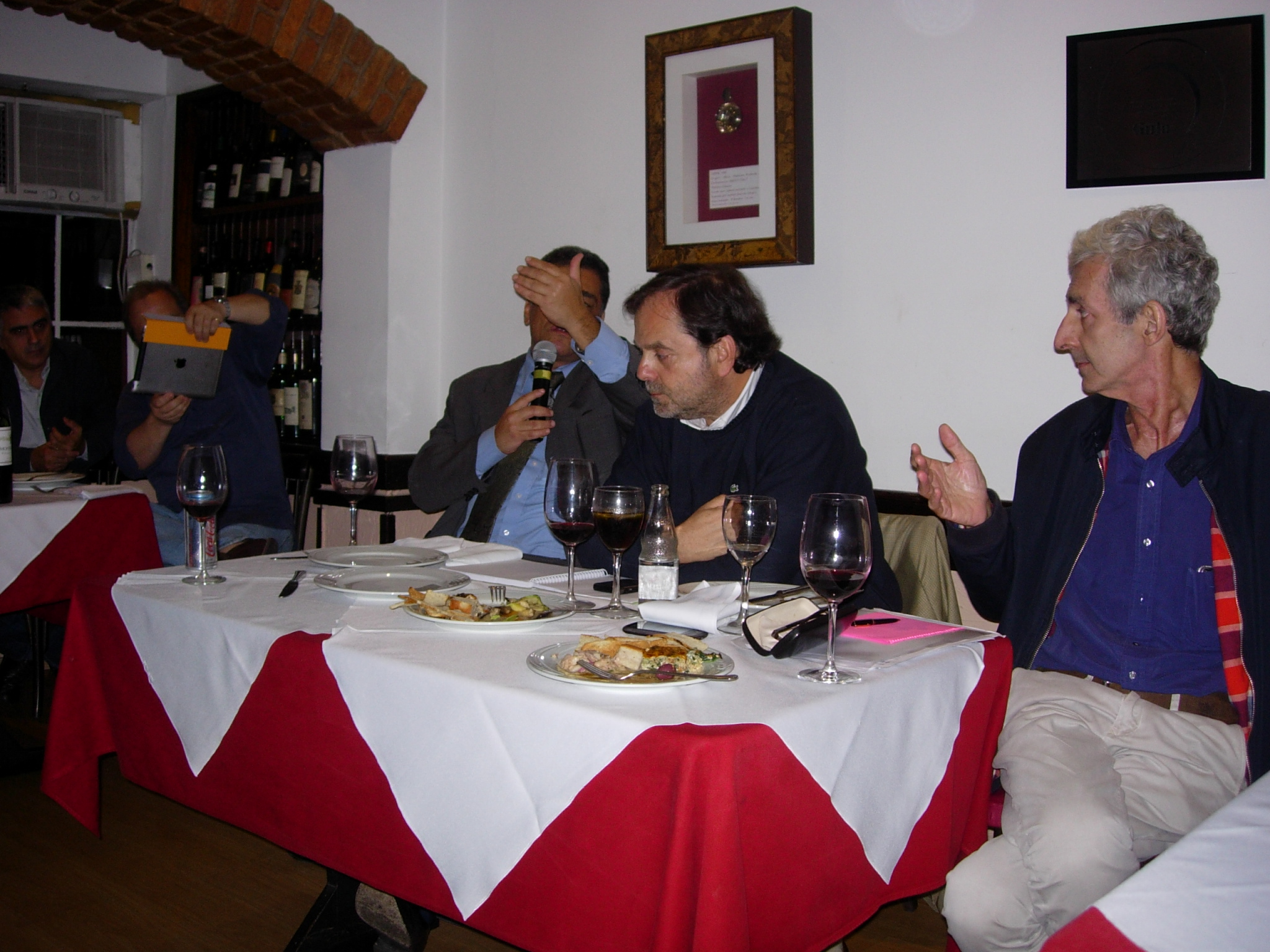
Anos depois encontrei com André numa festa de aniversário. Começamos aí uma conversa de anos, sobre a cidade do Rio de Janeiro, pontuada pelas emocionadas provocações dele nos debates do OsteRio.

Nunca vou me esquecer da vez que ele me chamou de Julia Roberts, quando quis fazer uma pergunta durante um debate. Rimos muito.

Aquele vinho tinto e aquela beringela da Osteria dell’ Angolo surtiram efeito, como bem ele planejava, ao criar o OsteRio nos moldes dos debates políticos entre vizinhos na Itália. Em 2010 eu já sentia a urgência de entrar na luta, de fazer alguma coisa para assegurar que a transformação tão-sonhada de todos nós não fosse totalmente efêmera.

Veio a ideia do blog, e pedi demissão do meu bom emprego na Editora Objetiva.

“Sensacional,” disse André, depois de ler meu primeiro post. “Yesss! ” eu pensei.

Ele soube do câncer tarde, e mesmo assim, como era a natureza dele, lutou de todas as formas possíveis. Ainda escrevia, dava palestras, pensava, cutucava. Amava muito os filhos, lindos, espirituosos e inteligentes como ele.

Que eles e todos nós levemos adiante a chama tão especial que era André Urani.

Posted in Brasil, Transformation of Rio de Janeiro / Transformação do Rio de Janeiro | Tagged | 6 Comments

When the maid’s quarters become the living room

Not a good sign at all for full and efficient urban integration

Para Quando o quarto de empregada vira sala, clique aqui

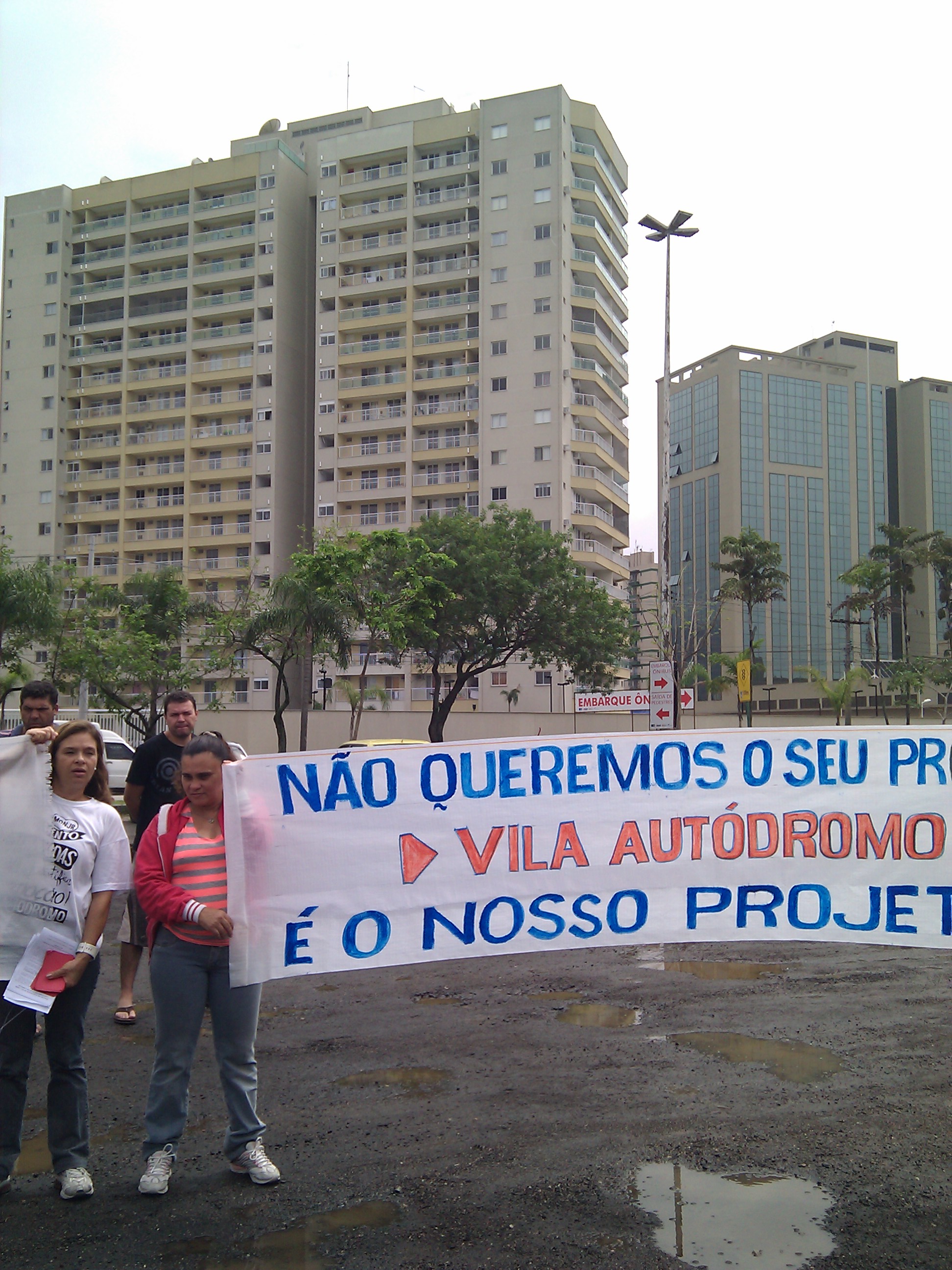
On last October 16, a humid Sunday, Municipal Housing Secretary Jorge Bittar met with Vila Autódromo residents  beneath a white-and-blue striped tent set up on an empty patch of ground next to their community. On the other side of the avenue an agglomeration of relatively new tall buildings served silent witness.

“I’m not going to do things the way it used to be,” the secretary promised. “At the time of the [2007 Pan-American Games]– that generated a lot of tension. We’re going to change.” Four days earlier, city agents had started an inventory of the vila‘s houses, writing numbers on façades with spray paint. Some frightened residents  shot a video of the encounter.

Vila Autódromo is just one favela–  the most visible– of many that are undergoing the trauma of Rio de Janeiro’s removals due to Olympics-related construction. According to the Municipal Housing Secretariat, 623 families have been relocated to give way to the rapid transit bus corridors starting to crisscross the city. Statistics for families being relocated due to urbanization work that’s part of the Morar Carioca program’s first phase aren’t available, nor is there an official estimate of future relocation.

In some favelas, there is discord, and confusing information regarding the removal of residents who may be living in areas at environmental risk.

Most of the relocated cariocas have no title to their houses nor to the plots they’re built on. But in Vila Autódromo, home to some 537 famílias on the edge of the Jacarepaguá Lagoon, residents received títulos de posse (possession titles) 17 years ago from then-governor Leonel Brizola. There are homes with forty years of history; some are large, with yards and animals.

By the estimate of Plataforma Dhesca Brasil, a UN-supported national grouping of 36 civil society movements and organizations, 5,846 carioca families have recently undergone the experience of removal or the threat of it. A report published in May of this year tallied and described dramatic cases of loss, including of physical and mental health. While Olympic authorities speak proudly of recycled construction materials at their building sites, city hall hasn’t removed the demolition rubble, subjecting those who remain to dengue fever, for example.

The mayor’s office says Vila Autódromo must come down because it sits on the Olympic Park site.

Each family had two choices, Bittar explained that steamy post-rainshower day: they could accept an apartment of about 430 square feet yet to be built on a nearby lot, with easy access to a park with barbecue pits, a health clinic, daycare center and school; or they could accept a payment calculated using a city table, of the cost of the materials used to build the house slated for demolition.

Whatever the numbers, relatively few people are affected by expropriation. Perhaps this is why the Dhesca report,  a letter from Amnesty International to the Olympic Committee,  two (melo)dramatic ESPN television programs, articles in The Guardian,  El País, USA Today,  plus accusations from bloggers, NGOs and a UN representative seem to have had little effect on the way the removals are carried out. Last year, the Rio state Public Defenders Office sent a notification to International Olympic Committee president  Jacques Rogge , with a copy to the Committee’s Ethics Commission, claiming that human rights were being violated.

It could be that dialogue, which the secretary also promised the residents that Sunday, is as yet a fairly unknown exercise in this authoritarian society. The (state, in this case) government doesn’t even listen to the middle class, for example, when it comes to plans for the new metro line.

What will be built where Vila Autódromo lies today? According to the Olympic Park’s winning project, nothing. “Ask the planners,” answered Bittar, when RioRealblog raised the question. At the meeting, a resident shouted out both a suppposition and a suggestion. “Put the builiding [that will be built here] there, where you want to take us.”

At the meeting, concerns were expressed. The apartments are small, in five-story buildings with no elevator. Residents will have to pay a maintenance fee. And, for ten years, they won’t be able to sell the unit, in contrast to the titles they now hold. For those who don’t want the apartment, the payment doesn’t take into account the value of the land to which residents hold title; with the cash the city is offering it will be impossible to buy a lot and build a house, especially in the current boom market (which thickens local newspapers, that tend to avoid relocation stories). And the buildings of the federal Minha Casa Minha Vida housing program, that the apartments will be part of, are notorious for poor construction quality.

For these and other reasons, at least half of the residents prefer to stay where they are, according to Agência Brasil.

In April 2011, in the wake of administrative changes in the Public Defenders’ office, the Housing and Land Nucleus team (that sent the notification to the Olympic Committee) quit in protest. Leonardo Chaves, Justice Vice Attorney General for Human Rights at the state Attorney General’s office, told RioRealblog in an interview that he’s working to persuade the mayor and governor to respect the constitutional rights to housing of residents subject to expropriation. Chaves, who criticized officials during the ESPN program, says he’s working behind the scenes; he showed RioRealblog no official document. “People went to live [in Vila Autódromo] because no one else wanted to. Now it’s a target of greed,” he vented.

At the meeting under the tent, a group demanded that the vila be urbanized, which is exactly what the winning British project proposes– and is also the current trend in urban design, practiced even in Rio, in the Morar Carioca program (strangely lacking a kickoff date for the execution of the winning projects of its second phase), set to urbanize all Rio’s favelas by 2020.

In Rio de Janeiro one hears nothing of contractors being required to build low-income housing in return for city permission to construct upscale projects, as is the case in other countries. The closest requirement is that the Olympic Park’s winning construction bidder will implant “the infrastructure (water and sewage systems, paving and lighting) […] of the lot on Estrada dos Bandeirantes where the families removed from Vila Autódromo will be relocated”.

The quote is from the call for bids published a week ago; this Monday a protest is planned in front of Rio’s city hall, against human rights violations related to upcoming mega-events.

Dan Epstein, Sustainability Director for the London Olympic Games, explained to RioRealblog, after a recent seminar organized by the Extra and  O Globo newspapers, that an independent real estate appraisal system exists in London, to determine payment in expropriation cases. But even in London, where very few people had to leave what would become the Olympic Park, there are complaints of injustice. The Chinese and their hutongs can’t be forgotten; and a comparison of the housing provided in South Africa for those removed because of the 2010 World Soccer Cup with the Minha Casa Minha Vida apartments makes the latter look palatial.

The PowerPoint presentation of the new housing for Vila Autódromo began late because of anInternet glitch, and it wasn’t easy to see anyway, because the sun shone so brightly. But it’s become irrelevant, at least for a while. Ten days before the meeting, the O Estado de São Paulo newspaper had revealed that the city of Rio was buying a lot to relocate Vila Autódromo residents, for US$ 11.7 million equivalent, from a construction company that had made 2008 campaign donations to mayor Eduardo Paes and his chief of staff.

“Three developments of the companies (two by Rossi and one by PDG)”, the São Paulo paper reported, “are next to Vila Autódromo and are likely to increase in value after the shacks are removed”. Fou days after this news, the mayor canceled the purchase. He now awaits a judicial opinion.

The history of Rio de Janeiro can be told as one episode after another of coming into the living room and finding someone who should be in the servants’ quarters sitting on the sofa. With a few exceptions, the living room keeps moving. “From 1962 to 1975, 140,000 people were removed,” says Rafael Gonçalves, a lawyer, historian PUC-Rio professor and author of Les favelas de Rio de Janeiro – histoire et droit, XIXe et XXe siècles.

About 17% of the city’s population live in favelas. This is a little less than one in five  people– and it’s more, when you take consider the entire metropolitan region.

Now, with the Olympics, the West Zone has become the living room. It happens in the best cities… and usually, the answer of the richer to the complaints of the poorer is “they shouldn’t have built their homes there to begin with”. The people who did this knew very well that it was an at-risk area, that they would never get title, or that the land could interest others, later.

But what about the integration of Rio, which is also happening because of the mega-events? The motto, repeated constantly by government officials, is  treat the favela or informal city the same as the formal city. Same services, same laws and responsibilities.

We’re in a time of transition, from a situation where people liked to park on the sidewalk, to one where tow trucks and municipal guards are circulating, buildings remove barriers, and pedestrians at last have free passage. We’re moving from a situation where people built their homes as best they could in last-resort locations, and even so, they created deep ties with their neighbors, to a situation where.. ? It’s not clear.

The state of affairs is reminiscent of Liquid Paper, the stuff in a bottle used to wipe out the old-fashioned typographical error. When you use Liquid Paper, it’s almost impossible not to end up either with a sticky white blob, or an illegible mixture of the wrong letter with the correct one.

And the lack of clarity regarding the issue of how people are treated who live in the path of the city’s transformation brings to light a worrisome ambivalence, on the part of government authorities. If by 2016 the transformation of Rio ends up being partial, or if it comes up against a political obstacle, this ambivalence will be the cause.

And the only solution to ambivalence is sure-handed, efficient, accountable and transparent leadership.

Here is a video and here is a print report on this subject, by the New York Times.

Posted in Brasil, Brazil, Transformation of Rio de Janeiro / Transformação do Rio de Janeiro | Tagged , , , , , , , , , , , , , , , , | 6 Comments

Quando o quarto de empregada vira sala

Presságio nada bom para uma integração urbana plena e eficiente

Num abafado domingo, dia 16 de outubro deste ano, o Secretário de Habitação Municipal Jorge Bittar se reuniu com moradores da Vila Autódromo debaixo de uma tenda listrada de branco e azul, montada em uma área livre ao lado da comunidade. Do outro lado de uma avenida, uma aglomeração de altos prédios de apartamentos relativamente novos faziam testemunho silencioso.

“Não vou fazer como no passado,” jurava o secretário. “Não época do PAN– isso gerou aquela tensão. Vamos mudar.” Quatro dias antes, a prefeitura iniciara o cadastramento das casas da vila, escrevendo números nas fachadas com tinta spray. Alguns moradores assustados filmaram a abordagem.

Vila Autódromo é apenas uma comunidade–  a mais visível– das que passam pela emoção das remoções que acontecem no Rio de Janeiro, em função da construção de equipamentos olímpicos. De acordo com a Secretaria Municipal de Habitação, 623 famílias já foram reassentadas para ceder lugar aos corredores de trânsito rápido de ônibus (BRTs) que estão em construção. Não estão disponíveis números sobre famílias reassentadas por causa de obras de urbanização pela primeira fase do Morar Carioca, nem existe uma previsão oficial de reassentamentos futuros.

Em algumas favelas, há discordância, e discrepâncias de informação sobre a remoção de moradores que estariam morando em áreas de risco.

A maioria dos cariocas removidos não possui título às suas casas ou aos terrenos em que essas se encontram. Mas na Vila Autódromo, que abriga umas 537 famílias à margem da Lagoa de Jacarepaguá, os moradores ganharam títulos de posse há 17 anos do então governador Leonel Brizola. Há casas com história de quatro décadas; algumas são grandes, com quintal e animais domésticos.

Pelas contas do Plataforma Dhesca Brasil, uma articulação nacional com apoio da ONU, de 36 movimentos e organizações da sociedade civil, 5.846 famílias cariocas passaram recentemente pela experiência ou pela ameaça de remoção. Um relatório lançado em maio deste ano contabiliza e descreve casos dramáticos de perda, inclusive de saúde física e mental. Enquanto as autoridades olímpicas locais se orgulham pela reciclagem de material na construção de equipamentos olímpicos, a prefeitura não retira o entulho das demolições, sujeitando quem fica à dengue, por exemplo.

A prefeitura diz que é preciso derrubar a Vila Autódromo porque está no lugar onde vai ser construído o Parque Olímpico.

Cada família teria duas opções, Bittar explicou naquele dia de sufoco pós-chuva: ou aceitava um apartamento de por volta de quarenta metros quadrados a ser construído num terreno próximo, com acesso fácil a um parque com churrasqueiras, posto de saúde, crêche e escola; ou aceitava uma indenização calculada através de uma tabela da prefeitura, de valores do material utilizada na construção da casa a ser demolida.

Quaisquer que sejam os números, as pessoas afetadas por expropriação são relativamente poucas. Talvez seja por isso que nem o relatório do Dhesca, nem uma carta da Amnesty International ao Comitê Olímpico nem dois (melo)dramáticos programas de televisão da ESPN, nem matérias do jornal inglês The Guardian, do espanhol  El País, do USA Today, muito menos questionamentos de blogueiros, de ONGs ou de uma representante da ONU parecem ter surtido efeito na condução das remoções. No ano passado, a Defensoria Pública do estado enviou uma notificação ao presidente do Comitê Olímpico Internacional, Jacques Rogge , com cópia a Comissão de Ética do Comitê Olímpico Internacional, de violação de direitos humanos.

Pode ser que o diálogo, também prometido pelo secretário aos moradores naquele domingo, seja um exercício ainda bastante desconhecido nesta sociedade autoritária. O governo (estadual, nesse caso) nem a classe média ouve, por exemplo sobre o traçado da nova linha de metrô.

O que será construído no local onde fica a Vila Autódromo? De acordo com o projeto vencedor para o Parque Olímpico, nada. “Pergunte aos planejadores,” respondeu Bittar, quando RioRealblog levantou a dúvida. Na reunião, um morador fez uma suposição e uma sugestão aos berros. “Coloque o prédio [que será construído aqui] lá onde você quer nos levar.”

Na reunião, preocupações se manifestaram. O apartamento é pequeno, em prédios de cinco andares sem elevador. Os moradores terão que pagar uma taxa de condomínio pela manutenção. E, por dez anos, não poderão vender o imóvel, ao contrário do título que possuem agora. Por outro lado, a indenização não leva em conta o valor do terreno ao qual o morador possui título; com o dinheiro que a prefeitura oferece, seria impossível comprar um terreno na região para construir uma casa, sobretudo no mercado atual de boom (que engrossa os jornais locais, que tendem a evitar o assunto de remoções). E os prédios do programa federal Minha Casa Minha Vida, do qual os apartamentos farão parte, são notórios pela má qualidade de construção.

Por esses e outros motivos, pelo menos metade dos moradores prefere ficar onde está, de acordo com a Agência Brasil.

Em abril de 2011, depois de mudanças administrativas na Defensoria Pública, a equipe do Núcleo de Terras e Habitação (que havia enviado a notificação ao COI) se demitiu em protesto. Leonardo Chaves, Subprocurador Geral de Justiça de Direitos Humanos do Ministério Público estadual, disse em entrevista com o RioRealblog que está se esforçando para persuadir o prefeito e o governador a respeitarem os direitos constitucionais à moradia, dos moradores das favelas sujeitos a remoção. Ele, que aparece no programa da ESPN fazendo críticas, diz que trabalha nos bastidores; não mostrou nenhum ofício ou outro documento. “As pessoas foram morar [na Vila Autódromo] porque ninguém quis. Agora virou o alvo da cobiça,” desabafou.

Na reunião debaixo da tenda, um grupo reivindicou a urbanização da vila, justamente aquilo que o projeto inglês vencedor propõe– ou seja, a tendência atual do urbanismo, até praticado aqui, por meio do programa Morar Carioca (estranhamente ainda sem data para o início da execução dos projetos vencedores da segunda fase), cuja tarefa é a urbanização de todas as favelas do Rio até 2020.

No Rio de Janeiro, não se ouve falar de construtoras sendo obrigadas a erguer moradias de renda baixa em troca de permissão da prefeitura para construir prédios de classe alta, como acontece em outros países. O mais próximo que se chega a isso é o requerimento de que a empresa vencedora da licitação para construir o Parque Olímpico irá implantar “a infraestrutura (rede de água, esgotos, asfalto e iluminação) […] do terreno na Estrada dos Bandeirantes para onde serão reassentadas as famílias retiradas da Vila Autódromo”.

A citação vem do edital lançado há uma semana; na segunda feira acontece um protesto frente à prefeitura do Rio, das violações de direitos humanos em função dos megaeventos vindouros.

Dan Epstein, diretor de Sustentabilidade dos Jogos Olímpicos de Londres, explicou ao RioRealblog, depois de um recente seminário organizado pelo jornais Extra e O Globo, que na capital britânica existe um sistema de avaliações independentes para a indenização, em casos de expropriação. Mas mesmo em Londres, onde poucas pessoas tiveram que sair do Parque Olímpico, há queixas de injustiça. Dos chineses e seus hutongs nem se fala; e os apartamentos do Minha Casa Minha Vida são palácios em face à moradia providenciada na África do Sul, àqueles que tiveram que sair de casa por causa da Copa do Mundo de 2010.

A apresentação PowerPoint das novas moradias para a Vila Autódromo tardou por falta de Internet no local, e em todo caso foi difícil de acompanhar, por causa da luz do sol. Mas já se tornou irrelevante, ao menos por um tempo. Pois dez dias antes da reunião, o jornal O Estado de São Paulo revelara que a prefeitura carioca comprava o terreno para o reassentamento dos moradores da Vila Autódromo, por R$ 19,9 milhões, de uma construtora que fizera doações à campanha de 2008 do prefeito Eduardo Paes e de seu chefe de gabinete.

“Três empreendimentos das empresas (dois da Rossi e um da PDG)”, dizia a reportagem, “são vizinhos à Vila Autódromo e deverão se valorizar após a remoção dos barracos”. Quatro dias depois da publicação da notícia, o prefeito cancelou a compra. Ele aguarda uma perícia judicial.

Pode-se contar a história do Rio de Janeiro como um episódio após o outro de chegar na sala e encontrar quem devia ficar nas “dependências”, sentada no sofá. Pois, com algumas exceções, a sala vai migrando. “De 1962 a 1975, 140 mil pessoas foram removidas,” diz Rafael Gonçalves, advogado, historiador, professor da PUC-Rio e autor de Les favelas de Rio de Janeiro – histoire et droit, XIXe et XXe siècles.

Por volta de 17% da população carioca mora em favela. Ou seja, um pouco menos do que uma em cinco pessoas; mais, quando se leva em conta a região metropolitana.

Agora, com as Olimpíadas, a Zona Oeste virou sala. Acontece nas melhores cidades… e geralmente, a resposta dos mais ricos às queixas dos mais pobres é “não deviam ter construído suas casas naquele local”. Quem fez isso sabia muito bem que era área de risco, que não teria título, ou que o terreno poderia depois interessar a outros.

Mas, e a integração do Rio de Janeiro, que acontece também por causa dos megaeventos? O lema, constantemente repetido pelas autoridades, é tratamento igual no morro ao aquele do asfalto. Mesmos serviços, mesmas leis e responsabilidades.

Estamos num momento de transição, de uma situação em que as pessoas procuravam estacionar na calçada, a uma em que os reboques e guardas circulam, os prédios removem os frades e os pedestres ganham a livre passagem. Vamos de uma situação em que as pessoas construíam suas casas do jeito que conseguiam em lugares inóspitos e mesmo assim, criavam laços profundos com os vizinhos, a uma situação em que.. ? Não está claro.

O quadro lembra o Liquid Paper, passado em cima de um erro tipográfico dos antigos. Dificilmente o resultado não fica uma bolota pegajosa de branco, ou um misto ilegível da letra errada com a correta.

E a falta de clareza na questão do tratamento das pessoas que moram no caminho da transformação da cidade denuncia uma ambivalência preocupante, da parte das autoridades governamentais. Se a transformação do Rio de Janeiro até 2016 acabar por ser parcial, ou se esbarrar em algum obstáculo político, será por causa dessa ambivalência.

E a única solução à ambivalência é liderança segura, eficiente, responsável e transparente.

Clique aqui para um vídeo e aqui para uma reportagem escrita sobre o assunto, do New York Times.

Posted in Brasil, Transformation of Rio de Janeiro / Transformação do Rio de Janeiro | Tagged , , , , , , , , , , , , , , , , | Leave a comment

Established artists cross Rio, with an invitation to follow in their footsteps

Para Artistas renomados atravessam a cidade e convidam a todos para seguir o caminho, clique aqui

“Travessias” at the Bela Maré warehouse: show breaks new ground, literally

The Maré Complex was built on a mangrove swamp

While all sorts of entitities and institutions, Good Samaritans and optimists have been zipping over to the recently-occupied Rocinha and Vidigal favelas to offer their help, a courageous and pioneering effort is taking shape on the other side of the city.

“I won’t drive in, sorry, it’s an area in conflict,” says a taxi driver, letting off a passenger at the corner of Bitencourt Sampaio and Avenida Brasil. Here, just before overhead walkway # 10, is the edge of the Nova Holanda favela, one of sixteen that make up the Maré Complex. This week, a man on his way back from walking his wife to the bus stop near here was shot and killed by a stray bullet in a battle between drug traffickers and civil police, said to be laying the groundwork for Rio de Janeiro’s next police pacification unit.

Fred Coelho, one of the curators, helps with the cleanup in front of the Bela Maré Warehouse

Located on the innermost North Zone shores of Guanabara Bay, the Complex is home to at least 130,000 residents, including drug and paramilitary gangs. Close to the Rio de Janeiro Federal University’s “Fundão” campus, it’s on of the best organized areas of the city; the NGOs Observatório de Favelas and Redes de Desenvolvimento da Maré are headquartered here.

Long-term violence partially explains the abandonment of dozens of industrial warehouses along the Avenida and nearby. Now, exactly one year after the Brazilian Army’s historic invasion of the Alemão complex, the depressing scenery may be about to change.

“The warehouse was closed for about fifteen years,” says Fred Coelho, one of the Travessias show’s curators. Actually it starts November 26 at 4 p.m. only a few safe steps from Avenida Brasil. Open until December 18, the show includes an exhibit, urban interventions, videos, performances, workshops, talks and parties.

In addition to Coelho, the curators are Daniela Labra and Luisa Duarte. Sponsors include Petrobras and the Rio de Janeiro State Cultural Secretariat, by way of a tax incentive law.

"A factory is transformed into another factory"-- Davi Marcos, photographer

Supported by the Observatório de Favelas and artist of the documentary Wasteland fame Vik Muniz, a group of artists have made a US$ 88 million equivalent downpayment on the warehouse in the photo above, renamed Bela Maré (Beautiful Tide) Warehouse.  To turn this show into the start of a fruitful relationship between Brazil’s visual arts and one of the city’s ugliest sections, they need a bit more than an additional US$ 70 million equivalent.

Neighboring warehouse, belonging to the Lia Rodrigues dance company, lent for the show

Rochelle Costi: "Don't throw out this material, it will be used"

Yesterday, artists and curators were setting up the artworks. Davi Marcos plans to place four giant photographs in nearby favela streets. Raised in the housing project on the other side of Avenida Brasil, he’s the sole local among those who are showing. In the classes offered at the Observatório, Marcos has taught dozens of photographers.

Mentioning that the area is dangerous only when heavily-armed police are stationed at the favela entrance, signaling a raid, Marcos sees the show as a chance to “bring the presence of art, with world-renowned people, to a space that the media and society ignore”.

Marcos also created a playful bit of photographic nostalgia with a former worker-turned-factory guard, who showed him how to operate one of the machines left behind.

Henrique Oliveira, putting together his labyrinth

The other participating artists are Alexandre Sá, André Komatsu, Chelpa Ferro (Luiz Zerbini, Barrão and Sergio Mekler), Eli Sudbrack (AVAF), Emmanuel Nassar, Fish Filet (Alex Topini, Fernanda Antoun and Felipe Cataldo), Henrique Oliveira, Lucia Koch, Marcelo Cidade, Marcos Chaves, Matheus Rocha Pitta, Michel Groisman, Raul Mourão, Ricardo Carioba, Rochelle Costi, and the Pandilla Photographic Collective.

For the first time, Raul Mourão created his kinetic sculptures using steel piping and clamps as a building technique, instead of solid bars and electric soldering. The assembly team customarily makes bleachers. “Usually I work with right angles,” says an engineer while testing a sculpture in the Lia Rodrigues Companhia de Dança‘s warehouse, a partnership with the Redes NGO. “The diagonals complicate things.”

After a visit, it’s not at all complicated to climb up and over the walkway crossing Avenida Brasil, to find transportation back to the South Zone. To the tune of a pirated cd, passing kiosks selling candy and snacks, you make your zigzaggy way through a legion of pedestrians: a man walking his bicycle, a couple lifting a baby carriage to get it down the stairs; a fellow coming home from work, empty lunch pail inside a plastic bag. The wood planking floor is a little loose, and when you least expect it, you realize you’re on top of it all, above a wide, humming, dizzying avenue, the scent of sewage slowly making its way to you from the other side.

And the angle has changed.

Posted in Brazil, Transformation of Rio de Janeiro / Transformação do Rio de Janeiro | Tagged , , , , , , , , , , , , , , , , , | 1 Comment

Artistas renomados atravessam a cidade e convidam a todos para seguir o caminho

Travessias no Galpão Bela Maré: mostra pioneira

A Maré surgiu num manguezal

Enquanto toda espécie de orgão e instituição, samaritano e otimista corre para ajudar nas recém ocupadas favelas da Rocinha e do Vidigal, na outra ponta da cidade acontece uma corajosa inciativa de vanguarda.

“Não entro não, está em conflito,” diz um motorista de táxi, ao deixar uma passageira na esquina da rua Bitencourt Sampaio com a avenida Brasil. É aqui, logo antes da passarela 10, que começa a favela Nova Holanda, uma das 16 comunidades do Complexo da Maré. Nesta semana, um homem que voltava do ponto de ônibus onde com todo o cuidado deixara a esposa, morreu numa troca de tiros entre traficantes e policiais civis, que preparam o terreno para a próxima UPP do Rio de Janeiro.

Fred Coelho, um dos curadores, ajuda na limpeza em frente ao Galpão Bela Maré

Localizado nos fundos da baía de Guanabara, o Complexo abriga pelo menos 130 mil moradores, entre os quais facções de narcotráfico e milicianas. Vizinha do campus do Fundão da UFRJ, é uma das regiões mais bem organizadas da cidade; as ONGs Observatório de Favelas e Redes de Desenvolvimento da Maré aqui tem suas sedes.

A longeva violência no local foi um dos motivos pelo abandono de dezenas de galpões industriais pela avenida e suas adjacências. Agora, exatamente um ano depois da histórica invasão do Complexo do Alemão pelo Exército, esse triste visual pode estar começando a mudar.

“O galpão ficou uns quinze anos fechado,” diz Fred Coelho, um dos curadores da mostra Travessias, que abre, na verdade, a apenas alguns passos seguros da avenida Brasil– no dia 26, sábado, às 16 horas. Com duração até o dia 18 de dezembro, a  mostra inclui uma exposição, intervenções urbanas, vídeos, performances, oficinas, palestras e festas.

Além de Coelho, a mostra tem curadoria de Daniela Labra e Luisa Duarte. Os patrocinadores são a Petrobras e a Secretaria de Cultura do Estado do Rio de Janeiro, via Lei do ICMS.

"Uma fábrica se transforma em outra fábrica"-- Davi Marcos, fotógrafo

Apoiado pelo Observatório de Favelas e Vik Muniz, um grupo de artistas já pagou um sinal pelo galpão na foto acima, batizado Galpão Bela Maré, de R$150 mil. Faltam mais R$ 120 mil para que essa mostra seja o começo de uma relação frutífera entre a bela arte visual brasileira e um dos ambientes mais degradados da cidade.

Galpão vizinho, da companhia de dança Lia Rodrigues, emprestado à mostra

Rochelle Costi trabalha com as sobras da fábrica

Ontem, artistas e curadores montavam suas obras. Davi Marcos pretende espalhar quatro fotografias gigantes nas ruas próximas da favela. Criado no conjunto habitacional do outro lado da avenida Brasil, ele é o único artista local dos expositores. Já ajudou a formar dezenas de fotógrafos, nos cursos oferecidos pelo Observatório.

Comentando que o local é perigoso apenas quando há policiais na entrada da favela, sinalizando uma incursão, Marcos vê a mostra como uma chance de “trazer a presença da arte, com gente renomada mundialmente, para um espaço que a mídia e a sociedade [ignoram]”.

Marcos também fez uma brincadeira nostálgica e fotográfica com o ex vigia e funcionário da fábrica, que mostrou para ele como operar uma das muitas máquinas largadas ali.

Henrique Oliveira, montando uma parede do galpão

Os outros expositores são Alexandre Sá, André Komatsu, Chelpa Ferro (Luiz Zerbini, Barrão e Sergio Mekler), Eli Sudbrack (AVAF), Emmanuel Nassar, Filé de Peixe (Alex Topini, Fernanda Antoun e Felipe Cataldo), Henrique Oliveira, Lucia Koch, Marcelo Cidade, Marcos Chaves, Matheus Rocha Pitta, Michel Groisman, Raul Mourão, Ricardo Carioba, Rochelle Costi, e  o Coletivo Pandilla Fotográfica.

Pela primeira vez, Raul Mourão criou suas esculturas cinéticas com a técnica construtiva de tubos de aço e braçadeiras, em vez de barra maciça e solda elétrica. A equipe de montagem costuma fazer arquibancadas. “Normalmente trabalho com ângulos retos,” diz um engenheiro durante o teste no galpão vizinho, que é fruto de uma parceria da ONG Redes com a Lia Rodrigues Companhia de  Dança. “O diagonal complica.”

Depois da visita, não é nada complicado subir a passarela que atravessa a avenida Brasil, para pegar uma condução de volta à Zona Sul. Ao fundo musical de um CD pirata, passando por quiosques que vendem balas e lanches, cria-se um caminho ziguezague entre uma legião de pedestres: um rapaz que conduz sua bicicleta, um casal que levanta o carrinho do bebê para descer as escadas; um homem que volta do trabalho, a marmita vazia dentro de um saco plástico. O chão é de tábuas de madeira meio soltas, e quando menos você espera, se dá conta de que está numa posição dominante, por cima de uma larga avenida que zune vertiginosamente, o cheiro de esgoto chegando vagarosamente do outro lado da via.

E o ângulo mudou.

Clique aqui para ler um texto sobre memórias e planos para o futuro, de Davi Marcos.

Posted in Brasil, Transformation of Rio de Janeiro / Transformação do Rio de Janeiro | Tagged , , , , , , , , , , , , , , , , | Leave a comment

Taboos / assuntos tabu

A caixa de Pandora?

Participe no RioRealblog. Quais são os aspectos tabu da transformação do Rio de Janeiro? Quais são as perguntas que permanecem no silêncio? Onde falta o debate?  Deixe seu comentário, abaixo!

RioRealblog would like to hear from you. What are the taboo aspects of the transformation of Rio? What are the questions that aren’t being asked, or answered (or both)? What kinds of debate are missing? Leave a comment, below!


Posted in Brasil, Brazil, Transformation of Rio de Janeiro / Transformação do Rio de Janeiro | Tagged , , , , , , , , , , , , , , , , , , , , | 6 Comments

Rocinha occupation: the day after

Next may be Complexo da Maré, while former druglord “Nem” is pressured to rat on corrupt police and the search is on for traffickers who got away; favela trash pickup is city’s first priority 

Photo by Taylor Barnes

Government officials have said that Rio de Janeiro’s integration is a learning process, and this was very apparent in yesterday’s occupation of Rocinha, Vidigal and Chácara do Céu favelas.

Strategy

Planning began four months ago according to O Globo newspaper, when state officials met with President Dilma Rousseff to extend the Army’s continued presence in the Alemão and Penha complexes, occupied for almost a year now. This freed up manpower and other resources for what will soon become Rio’s 19th pacified region.

Photo by Taylor Barnes

Almost two weeks ago, the Civil Police swept surrounding areas and Rocinha itself, coming up with pirated merchandise and weapons (including anti-aircraft rockets!), and making twelve arrests.

The action signaled that druglord Nem and his minions’ time was up; notably, he gave an interview Nov.4 to Época magazine (translated here, at the foot of yesterday’s post) before playing what may be his last soccer game for a long time. Found in the trunk of a diplomatic-plated car near the Lagoa last Thursday, he’s now in jail in Bangu, having laid some treacherous groundwork for himself by claiming to have paid half his proceeds every month to police. He’s said to have brought in over US$ 59 million equivalent, a year.

Since the day of Nem’s arrest, the Highway Police have been working roadblocks on routes leading out of the city, looking for fleeing drug traffickers. And the military police carried out operations, according to O Globo, in the North and West Zones, plus Niterói and Macaé, to impede criminal movement. These led to 37 arrests, eight deaths and the detainment of seven minors.

Now, the elite squad is sweeping homes, forests and brush, finding weapons and drugs.

Integrated efforts

According to O Globo, the Rocinha-Vidigal operation was a pioneering concerted effort among the Federal Police, Civil Police, the Military Police (and its elite squad division), and the Highway Police. Civil Police weren’t present during the invasion per se; responsible above all for intelligence work, this unit reportedly argued with Federal and Military police over who would bring Nem in, last week. It thus seems that police integration– long a stumbling block to urban safety– is a work in progress, too.

Photo by Taylor Barnes

Anti-corruption and human rights measures

“…The presence of Military Police Internal Affairs teams patrolling the entrances to Rocinha, Vidigal and Chácara do Céu favelas, replacing officers from the 23rd Battalion, indicated a strategic change in relation to other occupations for the implantation of police pacification units in Rio,” O Globo reported today. ” Concerned with corruption accusations made during the recovery of the Penha and Alemão complexes last year, top Public Safety Secretariat officials banned the presence of officers carrying backpacks in Rocinha, with a few exceptions, and set up a unit to direct operations.”

Corruption is also being targeted in a new police academy curriculum, but the problem extends all the way to the top of Brazilian government. More effective models and thorough housecleaning would certainly aid Rio’s urban integration efforts.

Public defenders and human rights activists were also present during the occupation.

Photo by Taylor Barnes

If the media, police and government officials give equal treatment to other, less visible and emblematic favelas, this bodes well for the North Zone’s Complexo da Maré, cited as next on the list for occupation and pacification. Would-be preparatory elite squad action there in the last month resulted in loud and angry citizen complaints. The shared territory of several drug and paramilitary gangs, the Maré complex of favelas is supposed to house the elite squad BOPE headquarters by year-end.

Rocinha is Rio de Janeiro’s most affluent favela, and its occupation may signal the end of an era, as Brazilians begin to debate drug decriminalization and the economy grows, with the expansion of the middle class. In the Época interview, Nem– known to be a sophisticated businessman– said he believes that drugs will be freely traded in less than twenty years.

Photo by Taylor Barnes

He also pointed to the labor shortage that cariocas are experiencing in just about every sector. “Because of the Rocinha PAC [Accelerated Growth Program],” he said, “Fifty of my men left the traffic to work on the construction sites. Do you know how many went back to crime? None. Because they saw that they had work and a future in civil construction.”

Posted in Brazil, Transformation of Rio de Janeiro / Transformação do Rio de Janeiro | Tagged , , , , , , , , , , , , | 1 Comment

Rocinha, Vidigal and Chácara do Céu no longer foreign territory

The idea was to impress everyyone

Searches began at daybreak Sunday, in homes, forests and brush

You can subscribe for free, “like” the Facebook page for ongoing news about the transformation of Rio, follow @Riorealblog on Twitter and on Tumblr. And feel free to share this post–

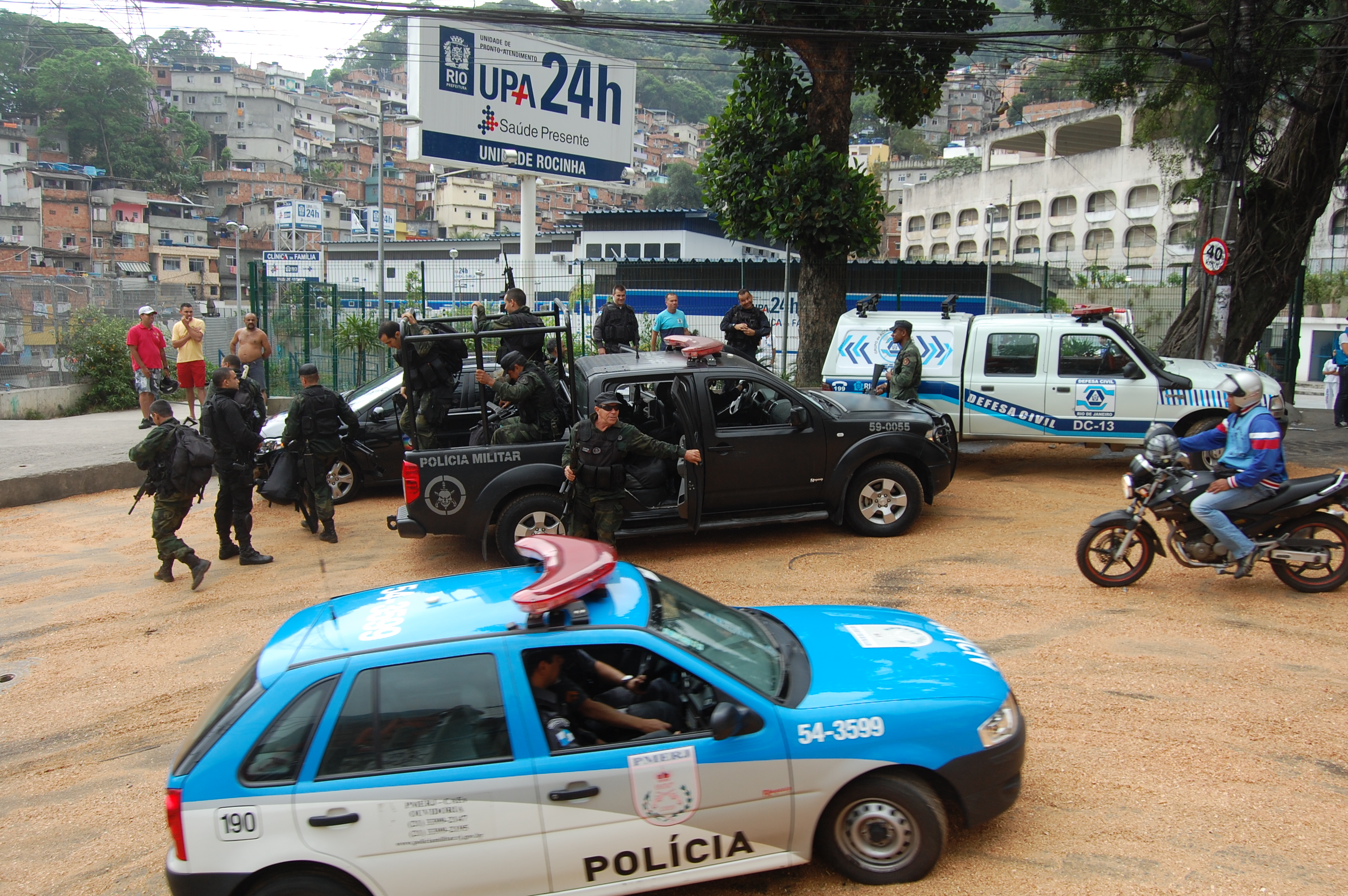
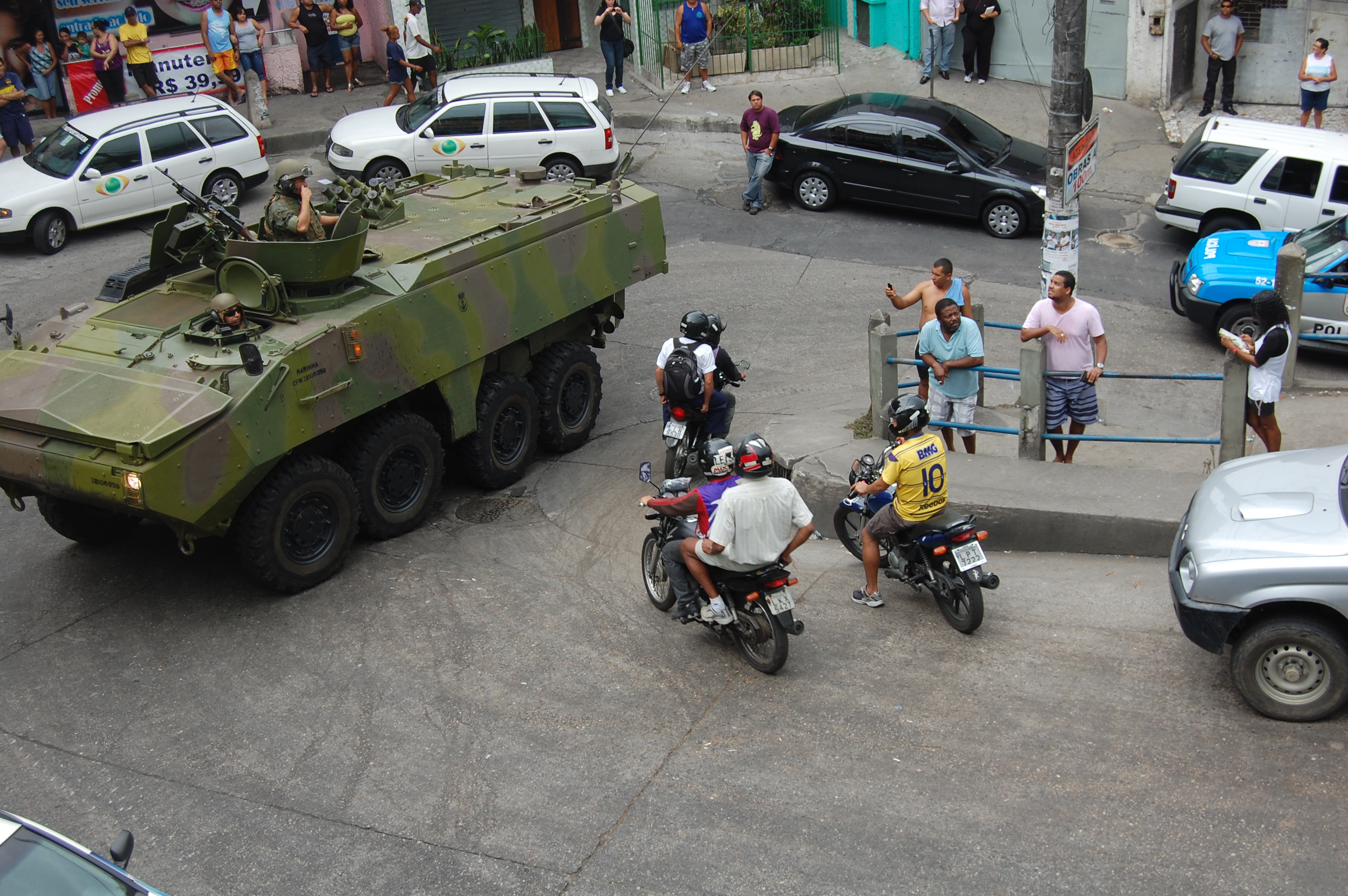
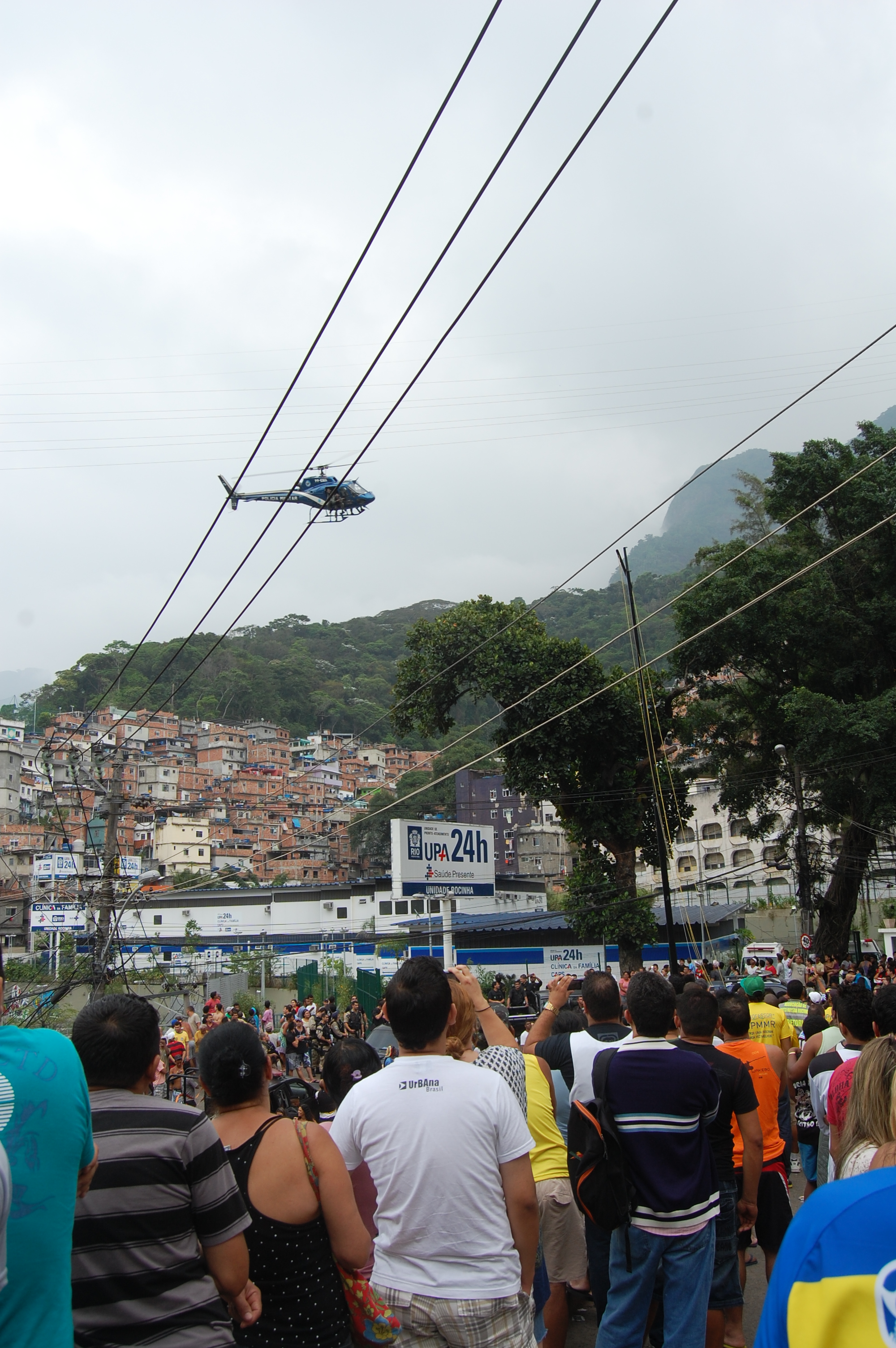
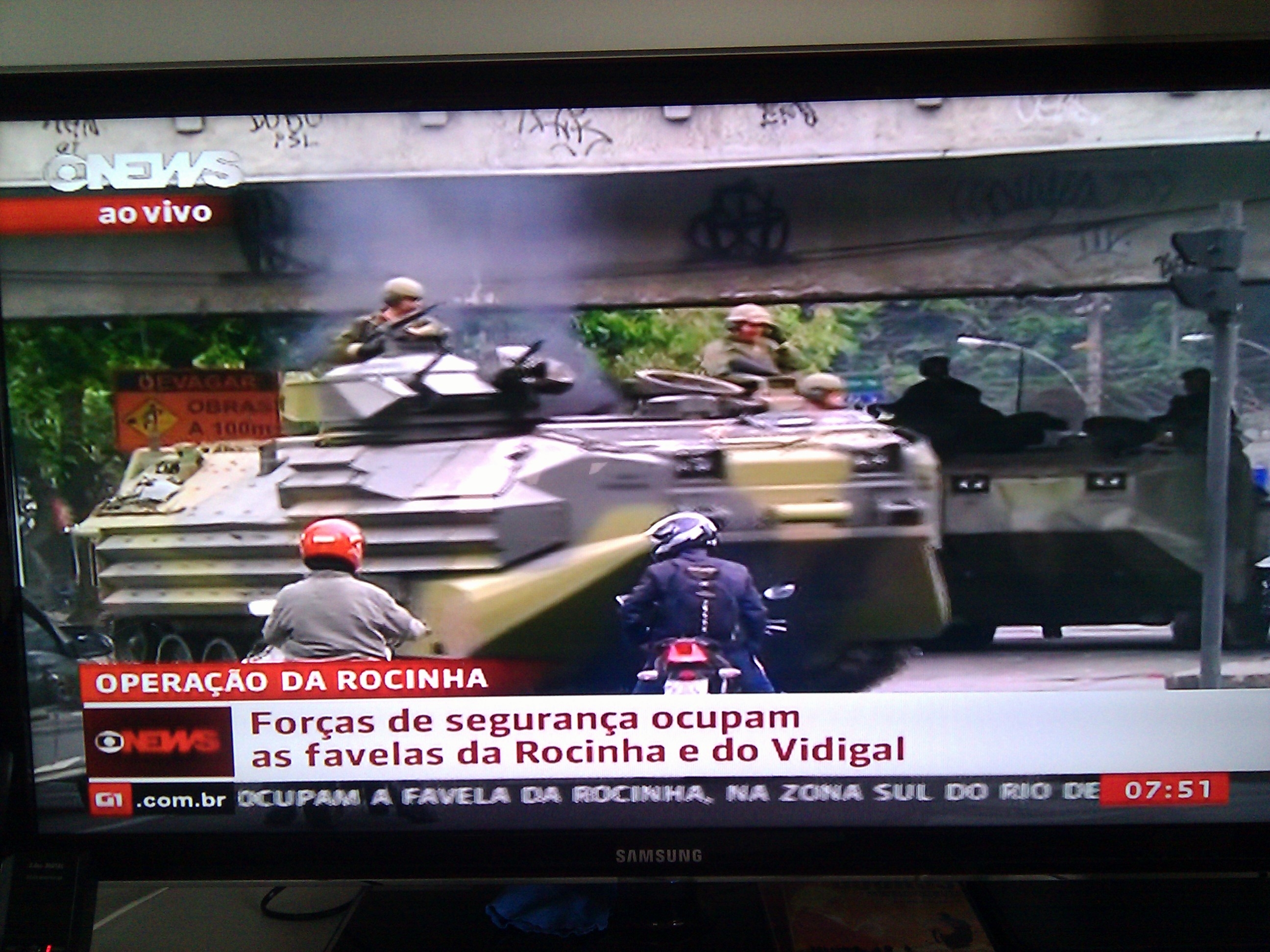
Reporting from the area, from both formal and informal media, indicate that the invading force of 700 military, civil, federal and highway police, with eighteen armored tanks, met with no resistance as they moved into Rio de Janeiro’s most glaring examples of the inequality in the Brazilian social structure at four-thirty a.m. today. Two hours later, police were turning the tanks around, while specialized units began their searches. Just when the next phase will begin– the installation of police pacification units– is unknown.

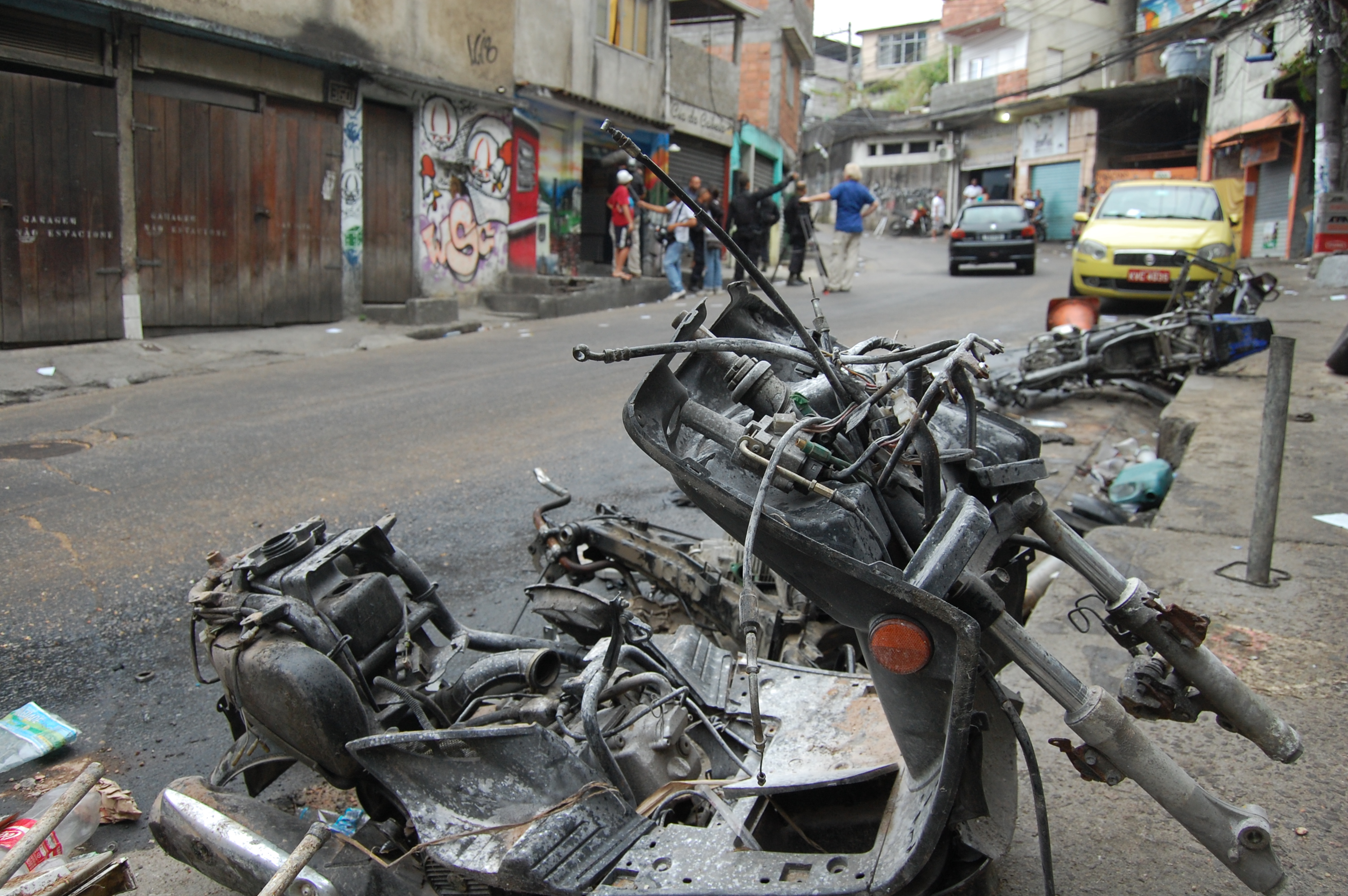
The worst problem was oil that traffickers had allegedly spilled on the entrance to Vidigal favela, which didn’t stop the tanks but turned treacherous many workers’ morning post-occupation descents.

One arrest occurred, of an alleged trafficker named Igor.

Civil Police chief Martha Rocha made a plea early this morning on TV Globo, for the favelas’ women to inform police of the whereabouts of weapons, criminals and drugs– using the independent “Disque Denúncia” telephone service. “Don’t stay silent,” she advised, citing the number.

Observers and residents were fearful about the searches, given the military police’s spotty human rights track record during searches carried out in the Alemão and Maré favela complexes, among others. This time, human rights activists will be watching closely and reporting on police work.

Thursday, Rocinha-Vidigal druglord “Nem”, Antônio Francisco Bonfim Lopes, was arrested as he fled in a car trunk, but two other traffickers are said to have taken over his business, which he claims was making close to US$ 60 million equivalent a year. According to him, half of this went to police, his virtual partners. Nem is now in a Bangu prison, set to be transferred out of state soon.

A couple of small favelas in the South Zone are still controlled by traffickers, but today’s news means that this part of the city is pretty much fully “liberated”– i.e. its most important favelas are in the process of becoming part of the formal city of Rio de Janeiro. Key to this process will be increased municipal and state services to these heretofore excluded urban areas.

Many observers and favela residents say that the provision of such services is still lacking in the eighteen favelas that already have police pacification units. For Facebook users, here is an intelligent drawing that made the rounds on Friday, illustrating the situation.

Next, the Today Show broadcasting live from Rocinha?

Today’s invasion received the most media attention, Brazilian and foreign, of any undertaken so far. O Globo newspaper ran real-time online reporting, just as it does for soccer games. Tweeting from Rocinha was nonstop.

Residents of Rocinha and Vidigal favelas work in homes, businesses, schools, clubs, and shopping centers of São Conrado, Leblon, Gávea, Lagoa and Ipanema, among other parts of Rio. These are the city’s most affluent neighborhoods.

Whether the limelight will also shine on outstandng public safety challenges– militias, police corruption and training, and the hundreds of Rio favelas that still lie beyond the Pale of urban services– remains to be seen. This attention will be key to the integration of a city where the poor have been ignored for centuries, as it struggles to provide safety for all residents and future visitors.

Yesterday, Época magazine published a Nov.4  interview with Nem, witheld until his arrest. The interview is clearly an attempt to curry favor with government officials and society in general. Nem has much to fear, particularly from the police he now says he used to pay off. Below, a translation.

My Meeting with Nem

By Ruth de Aquino

It was Friday November 4. I got to Two Street at six p.m. This is the location of a house in an alley recently purchased by Antônio Francisco Bonfim Lopes, Nem, for US$ 68,000 equivalent. A ten-minute car ride separates my house on the “asphalt” from the heart of Rocinha. By way of favela contacts with a church that works with drug addicts and traffickers, and prostitutes, a meeting with Nem had been set up. At 35, he’d been the druglord in the favela for six years. He owned the hill.

I wanted to understand the man behind the myth of the city’s “enemy number one”. Nem is called “president” by those around him. Feared and courted. On Tuesdays, he received community members and went through requests and disputes. Friday was payday. They told me he slept days and worked nights – and that he is very close to his mother, with whom he goes out arm-in-arm, to chat and drink beer. He bought several houses recently and there were rumors he’d turn himself in soon.

As soon as I got there, I heard I’d walked right by him, playing ping-pong on a table in the street. Everyone knew I was a person “from outside”, from the other side of the invisible wall, on the asphalt. Open sewers and a mountain of trash on the corner signaled the abandonment of a street that used to have a police post, now closed. An empty can passes humming by my face– thrown by a girl in shorts passing by on a motorcycle.

I waited three hours, was taken to different places. My intermediaries were nervous, because “heads would roll if I had a button mike on my clothes to record, or a hidden camera”. I got to the point of asking: “Aren’t things a little backward? Shouldn’t I be nervous and afraid?” At nine p.m., on the back of a motorcycle, without a helmet, I rode up dark and hole-ridden alleyways, skirting buses and hearing the noise of Rocinha, a mixture of funk, loudspeakers and televisions in street bars. I crossed paths with the blonde Danúbia, Nem’s current wife, riding an orange motorcycle, long hair down to her waist. I went all the way to the top, to Vila Verde, and got my first surprise.

I didn’t find Nem in a hidden room, surrounded by armed men. The scene couldn’t be more innocent. It was public, well lit and open: Rocinha’s new soccer field, with synthetic grass. Children and adults played. The sky was starry and the view was of the shacks that are home to 70,000 residents. Nem was getting ready to play. He wrapped his right ankle. During this ritual he hardly looked at me. He talked to a pastor about a 22-year-old drug addict: “Did you get him, pastor? You can’t give up. The church can’t give up on anyone’s recovery. Man, he was clean, no drugs, he’d found a job… keep me posted,” said Nem. He put on his socks, then an ankle support, and got up, looking straight at me.

That was the second surprise. Tall, brown-skinned, and muscular, very different from the photo commonly seen in the media, of a skinny guy with a dyed fluff of hair in the front and an uninviting smile, a bit like the Joker. Nem is the father of seven children. “Two adopted me; they call me dad and ask for my blessing [a Brazilian custom, particularly among the lower classes].” The youngest is a baby with Danúbia, who set up a beauty salon, according to him “with a bank loan, and making the payments”. Nem is a devoted Flamengo fan. But he wore blue and white, the colors of his team in the favela. Sleeveless Nike shirt, baseball cap, soccer shoes.

“What position do you play, Nem?” I asked.

“Stubborn,” he said, laughing, “My ankle is messed up and no one respects me anymore on the field.”

It was a thirty-minute conversation, standing up. Well-mannered, calm, he called me  m’am, didn’t use swear words and didn’t comment on the accusations against him. He said he wouldn’t give an interview. “What for? No one is going to believe me, but I’m not the most dangerous bandit in Rio.” He didn’t want a tape recorder or photos. My silence was kept until his arrest. What follows is the reconstitution of part of our conversation.

Police Pacification “Rio needed a project like this. Society is right to no longer accept bandits coming down the hill, armed, to rob on the asphalt and then go back. Here in Rocinha there are no car thefts, no one steals anything, sometimes just a motorcycle or two. I don’t like to see a bandit with a bunch of weapons hanging off him, dressed up like that. The UPP is an excellent project, but it has problems. Imagine the badly-paid police, even the new ones, controlling all the alleys of the favela. How many won’t accept R$ 100 to ignore a drug trafficking post?”

[State Public Safety Secretary José Mariano] Beltrame “One of the most intelligent guys I’ve seen. If there were more guys like him, everything would be better. He says what has to be said. Police pacification is no use if it’s just police occupation. You have to have sports areas, create opportunities. How can Cuba have more medals than we do, in the Olympics? If a poor family’s child  took the Enem [college entrance exam] with the same chances of a rich family’s child, he wouldn’t get into drug trafficking. He’d go to college.”

Religion “I’m not going to Hell. I always read the Bible, I ask my children every day if they went to school, I try to stop kids from getting into crime, I give people money for food, rent, school, to get out of here. I hold services in my home, I ask pastors to come. But I have no connection to a particular church. My connection is to God. I learned to pray as a child, with my father. But I only started to understand [evangelicals] about seven years ago. I think God has a plan for me. He’s going to open a door.”

Prison “The life of crime is very bad. I and a load of other people want to leave it. What’s good is going to the beach, the movies, going out with your family without being afraid of being followed or killed. I would like to sleep in peace. Take my child to the zoo. I’m afraid of not being enough for my children. Because a father has more authority than a mother. He says no, and it’s no. In Colombia, they took millions of Farc guerrillas out of crime because they gave amnesty and a chance for them to rejoin society. I’m not asking for amnesty. I want to pay my debt to society.”

Drugs “I don’t use drugs, I just drink with friends. I think marijuana will be [decriminalized] in less than twenty years in Brazil. In the United States, it almost is. Can you imagine how much money businesses will make? They’ll swallow up the drug traffic. I don’t deal crack and I don’t allow crack in Rocinha. Because it destroys people, families and the whole community. I know people who  have used cocaine for thirty years and can function. But with crack, people steal and rob anything they come across.”

Recovery “I send prostitutes and drug addicts to a recovery center in City of God. These kids need family and future, so as not to get into prostitution or get sick with AIDS. For police pacification to work, there has to be social inclusion of people like this. That’s what Beltrame says. And I say to all of mine who are in the traffic: the time is now. If you want to recover go to the church and turn yourself in to pay what you owe and save yourself.”

Idol “My idol is Lula. I love Lula. He fought crime with the most success. Because of the Rocinha PAC [Accelerated Growth Program], fifty of my men left the traffic to work on the construction sites. Do you know how many went back to crime? None. Because they saw that they had work and a future in civil construction.”

Police “I pay a lot every month to the police. But I have a lot more friends who are police than police I pay. They know that I give orders not to shoot police coming into the favela. They are all fathers, they come here because they’re ordered to, should they get a bullet for no good reason?”

Traffic “I know they say I went into the drug traffic because of my daughter. She was ten months old and had a very rare illness, she needed a catheter, a very expensive thing, and Lulu (the former druglord) lent me the money. But I would rather say that I went into the traffic because I just did. And it doesn’t pay.”

Nem wanted to play soccer. He’d just left the gym where he works out. He didn’t tell me to leave, but I could see my time was up. I walked down. It took a long time for me to get to sleep.

Posted in Brazil, Transformation of Rio de Janeiro / Transformação do Rio de Janeiro | Tagged , , | Leave a comment

Rocinha druglord arrested in diplomatic car trunk

The rest should be simple

Seen as the most intelligent and sophisticated of Rio’s drug traffickers, Rocinha’s “Nem”, Antônio Francisco Bonfim Lopes, 35, scurried down no sewage pipe, as some are said to have done a year ago, in the Complexo do Alemão. Neither did he go out shooting, as many Rocinha and nearby São Conrado residents feared.

He’d already tried faking his own death, in January 2010.

Around midnight, Nem fled in the trunk of a car with diplomatic plates. The driver identified himself as the consul of the Congo and at first refused to undergo a search as he drove out of the favela. Police agreed to conduct the search at a police station. On the way, in front of the Piraquê club on the Lagoa, the car stopped. The would-be consul offered R$30,000 to the cops, who proceeded to open the trunk. Dressed in a blue-striped button-down shirt and black slacks, Nem put up his hands.

Police also found a million reais in the car.

According to an interview on Globo’s morning news show with Victor Poubel, chief of the Federal Police’s Organized Crime Division, Nem was thankful to be taken in by the more professional Federal Police, instead of the Military Police. From the police station he called his mom, and gave instructions for his children to go to school as usual– though Rocinha’s schools haven’t been functioning as usual in the last few days, in expectation of the elite squad invasion announced for this Sunday.

According to Poubel, Nem– druglord for last four years– plans to serve time in prison (He’s being taken to Bangu this morning) and go straight upon release. He’s accused of drug trafficking and money laundering and may be responsible for the disappearance and probable death of a young woman last May who is said to have been a police informer. If any drug trafficker were to write a book– and make it a bestseller– it would be Nem, who also ran things in Vidigal favela.

In August 2010  Nem’s men invaded the Intercontinental hotel in neighboring São Conrado, taking hostages, after they’d been ambushed on their way home to Rocinha from a dance in Vidigal. The invasion ended peacefully, with negotiation and arrests.

Yesterday, Federal Police carried out fourteen Rocinha arrests as a result of phone taps. Two are said to be drug traffickers who had taken refuge in Rocinha after their own territories had been occupied and pacified; one a military police officer, and two former civil police officers. The police were attempting to “escort” the drug traffickers out of the favela.

Rocinha’s population is estimated at 70,000. If all goes smoothly on Sunday, Rocinha and Vidigal will soon have pacification units, and Rio’s entire South Zone will be considered pacified, with a couple of minor exceptions. Of course this doesn’t mean an end to drug trafficking– only less violence, more order, and an increased presence of city agencies in these favelas.

Police will continue to deal with a myriad of other challenges, including militias, police corruption and management issues and violence in the West Zone.

“The breaks the paradigm of territory as empire,” said State Public Safety Secretary José Mariano Beltrame in a telephone interview with TV Globo, from Berlin.

Today will also see a giant demonstration in downtown Rio, organized by Governor Sérgio Cabral, against a congressional bid to reduce the state’s petroleum royalties. You can follow breaking events on the blog’s Facebook page and on Twitter, by way of @Riorealblog. Riorealblog is also connected to Tumblr and Google+. For regular posts, sign up for a free subscription. Feel free to share any post.

Posted in Brazil, Transformation of Rio de Janeiro / Transformação do Rio de Janeiro | Tagged , , , , , , , , , , | 6 Comments

Pacification fallout: first journalist death (among many others)

While Rio police juggle priorities, violence and fear are still present

According to O Globo newspaper, yesterday TV Band cameraman Gelson Domingos da Silva, 46, was the first journalist to die in Rio de Janeiro covering during a shootout between police and criminals. Silva was wearing a protective vest, but it didn’t stop a rifle bullet.

In 2002 Globo TV reporter Tim Lopes was executed by drug traffickers, in the  Complexo do Alemão.

Yesterday’s shootout, which took place in the West Zone of Rio, brings home the more negative implications of Rio’s new public safety policy, implemented starting in 2008. Elite squad occupation, followed by police pacification units and increased municipal services and social programs, has up to now taken place in eighteen favelas or groups of favelas, mostly in the South and North Zones of the city. Policymakers initially said that pacification would focus on these areas.

The poorer West Zone has only one police pacification unit, in Batam. Before the unit was installed, a paramilitary gang tortured three undercover O Dia journalists in Batam, in May, 2008.

As pacification makes inroads, drug traffickers have moved to other favelas and, as in the case of the area where Silva was killed, Antares favela, they try to wrest control from ensconced paramilitary gangs. Militia groups dominate in the West Zone, more than in other areas of the city.

On Friday, a battle between police and alleged criminals in West Zone Vila Kennedy brought panic and school closures, as fleeing targets invaded a school. State Public Safety Secretary José Mariano Beltrame said that additional pacification units will be installed in the West Zone, but he didn’t say when. Rio’s police are reportedly about to occupy and pacify the one remaining South Zone favela, Rocinha, Nov. 13. Beltrame has also said,in the wake of a judge’s assassination and the arrest of alleged police perpetrators, that paramilitary groups are top priority. So is police corruption.

According to O Globo, a battle has raged in the Vila Kennedy area for five months, with homicide statistics there skyrocketing, in contrast to the numbers in the rest of the city, which have been declining. Vila Kennedy has seen thirty deaths since May.

The occupation and pacification policy’s overall success may have also created an exaggerated sense of safety, for some.  Globo reports that Silva, with long experience in reporting on favela violence, went ahead with two police– praying all the way– while other reporters stayed behind. According to a Globo photographer, a communications gap between shock troops and the elite squad resulted in yesterday’s shootout.

Silva’s last footage is embedded in O Dia newspaper’s report on his death, here.

Posted in Brazil, Transformation of Rio de Janeiro / Transformação do Rio de Janeiro | Tagged , , , , , , | 4 Comments